Partnership Disputes in Anne Arundel County: How Mediation Can Save Your Business
Originally published: July 2025 | Updated: July 2026 | Reviewed by Don Saunders
Partnership disputes in Anne Arundel County threaten business stability, drain finances, and fracture professional relationships that took years to build. Business mediation offers a faster, private, and less adversarial path to resolution than courtroom litigation.
Saunders Mediation, based in Annapolis, helps business partners resolve disagreements over finances, roles, and decision-making authority through structured negotiation sessions guided by a neutral mediator.
Partners retain control of the outcome, protect confidential business information, and preserve working relationships that courtroom proceedings typically destroy.
Key Takeaways
Partnership disputes over finances, roles, and decision-making cost Anne Arundel County businesses an average of 30% of annual profits when they escalate to litigation.
Mediation resolves most business partnership conflicts within a few sessions, compared to months or years in Maryland circuit court.
A signed mediation agreement is enforceable as a binding contract under Maryland law, giving both parties a clear path forward.
Saunders Mediation provides neutral, confidential mediation services for business partners in Annapolis and throughout Anne Arundel County.
A partnership dispute doesn’t have to end your business — Saunders Mediation helps Annapolis partners protect what they’ve built through confidential resolution sessions.
What Are Partnership Disputes in Anne Arundel County?
A partnership dispute is a disagreement among two or more business co-owners that disrupts operations, decision-making, or the company’s financial health. Under the Maryland Revised Uniform Partnership Act (Corps. & Ass’ns § 9A-202), a partnership forms when two or more persons carry on as co-owners of a business for profit — whether or not they use a formal partnership agreement.
This statutory framework establishes fiduciary duties of loyalty and care that each partner owes to the partnership and to the other partners. Disputes arise when one or both partners believe these duties have been breached, or when the partners simply cannot agree on the direction of the business.
In Anne Arundel County, the Circuit Court’s ADR program actively encourages mediation for business and commercial cases before trial. Saunders Mediation works with partners at every stage — from early-warning disagreements to disputes that have already resulted in legal filings.
Common Causes of Business Partnership Disputes
Partnership conflicts rarely emerge from a single event. They develop over time as small frustrations compound into fundamental disagreements about the business.
Financial Disagreements and Profit Distribution
Disputes over money remain the most common trigger for partnership breakdowns. These conflicts include disagreements over profit-sharing ratios, capital contribution requirements, salary draws, reinvestment strategies, and expense approval authority.
One partner may believe the other is receiving more compensation than their contribution warrants, or the partners may disagree about whether profits should be reinvested or distributed.
Common Financial Dispute
Typical Trigger
Risk to Business
Profit-sharing disagreement
Unequal workload vs. equal split
Partner withdrawal or lawsuit
Capital contribution conflict
One partner unable or unwilling to contribute
Operational cash shortfall
Expense authority dispute
Unauthorized spending by one partner
Eroded trust, financial exposure
Salary draw imbalance
One partner drawing above agreed amount
Resentment, forensic accounting costs
Unequal Contributions and Role Confusion
When partnership agreements fail to clearly define each partner’s responsibilities, one partner often shoulders a disproportionate operational burden.
This imbalance breeds resentment, especially when both partners share profits equally despite unequal effort. Role confusion also leads to duplicated decisions, contradictory instructions to employees, and operational inefficiency that clients and vendors notice.
Additional causes include differing growth visions — one partner pursuing aggressive expansion while the other prioritizes stability — and breakdowns in day-to-day communication that allow small misunderstandings to escalate into adversarial positions.
If you’re ready to get
started, call us now!
How Partnership Disputes Affect Your Business
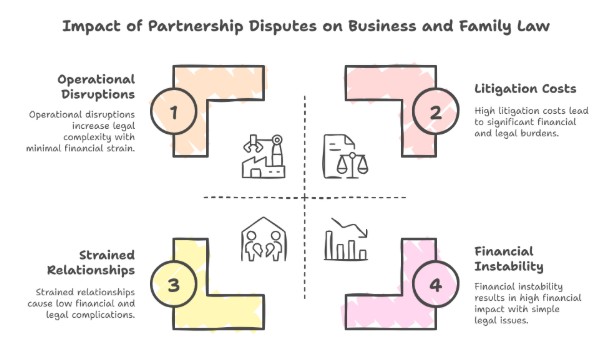
Unresolved partnership conflicts create cascading damage across every aspect of a business operation. Financial instability emerges first — frozen bank accounts, halted capital expenditures, and diverted attention from revenue-generating activities.
Employees sense the tension, productivity drops, and key staff members begin looking for more stable employment.
A litigation cost survey by the U.S. Courts documented that businesses lose significant revenue to legal fees, discovery costs, and operational disruptions during partnership lawsuits. In Anne Arundel County, civil litigation through the circuit court can extend 12 to 36 months for complex commercial cases.
Impact Area
Litigation Path
Mediation Path
Timeline
12–36 months
2–6 weeks
Cost
$50,000–$250,000+ in legal fees
$3,000–$10,000 typical
Confidentiality
Public court records
Fully private sessions
Relationship outcome
Adversarial, often irreparable
Collaborative, preservation-focused
Business continuity
Frequently disrupted
Maintained during process
Beyond finances, partnership disputes that reach public court proceedings damage the business’s reputation with customers, vendors, and lenders in the Annapolis business community.
Don’t let a partnership disagreement become a public courtroom battle — Saunders Mediation helps Anne Arundel County business owners resolve disputes privately and move forward with clarity.
Why Mediation Works for Partnership Disputes
Mediation places both partners in a structured, confidential environment with a neutral mediator who facilitates productive conversation — not a judge who imposes a decision.
Partners retain full control over the outcome and can craft creative solutions that a court cannot order, such as phased buyouts, restructured roles, amended operating agreements, or trial operational periods.
Industry data shows that business mediation resolves approximately 70–80% of commercial disputes, with over 90% of participants reporting satisfaction with the process regardless of outcome.
Mediation resolves most business conflicts within 30 to 45 days, compared to years in litigation.
Mediation vs. Litigation vs. Arbitration
Business partners facing a dispute have three primary paths to resolution. Understanding the differences helps partners make an informed decision about which process fits their situation.
Mediation, arbitration, and litigation each serve different purposes. Mediation is voluntary and non-binding until both parties sign a settlement agreement. Arbitration produces a binding decision from a neutral arbitrator — faster than court but without the collaborative flexibility of mediation.
Litigation places the outcome entirely in the hands of a judge or jury, with all the cost, delay, and public exposure that entails.
Factor
Mediation
Arbitration
Litigation
Decision-maker
The partners themselves
Neutral arbitrator
Judge or jury
Binding?
Only when agreement is signed
Yes, final and binding
Yes, subject to appeal
Confidential?
Yes
Typically yes
No — public record
Timeline
Weeks
Months
1–3+ years
Cost
Lowest
Moderate
Highest
Relationship impact
Preserves
Neutral
Adversarial
For most Anne Arundel County partnership disputes, mediation is the strongest first step — partners can always escalate to arbitration or litigation if mediation does not produce an agreement.
The Mediation Process for Partnership Disputes in Annapolis
Saunders Mediation follows a structured process designed to efficiently move business partners from conflict to resolution.
Initial Consultation and Issue Identification
The process begins when one or both partners contact Saunders Mediation to schedule an initial consultation. During this meeting, the mediator establishes ground rules, explains how mediation works, and gathers background information about the dispute.
Each partner presents their perspective without interruption. The mediator identifies the core issues — financial disagreements, role disputes, strategic direction conflicts, or trust breakdowns — and creates an agenda that prioritizes the most critical items.
This structured identification process prevents sessions from devolving into unproductive arguments. The mediator ensures both partners feel heard and understood before moving into negotiation.
Negotiation and Settlement Agreement
Once issues are identified, the mediator facilitates negotiation sessions where partners explore potential solutions. The mediator may use joint sessions, private caucuses, or a combination of both to help partners move past entrenched positions toward mutually acceptable terms.
When partners reach an agreement, the mediator helps draft a settlement agreement that documents every term — financial arrangements, role definitions, decision-making authority, dispute-resolution procedures for future disagreements, and any buyout or restructuring provisions.
This signed agreement functions as an enforceable contract under Maryland law. Both partners leave with a clear, written roadmap for moving forward after the dispute.
If you’re ready to get
started, call us now!
How to Prepare for Partnership Mediation
Effective preparation directly increases the likelihood of reaching a resolution. Partners who arrive organized and clear about their priorities resolve disputes faster and with better outcomes.
Gather all relevant financial records — income statements, balance sheets, cash flow reports, and tax returns — that document the partnership’s economic position. Bring the partnership agreement, any amendments, and correspondence between partners that relates to the dispute.
Before the first session, each partner should identify three categories of goals: outcomes that are essential and non-negotiable, outcomes that are preferred but flexible, and outcomes that would be ideal but could be traded in exchange for other priorities.
This internal ranking gives partners negotiating clarity and helps the mediator identify areas of overlap.
Approach the process with a willingness to listen. The partners who achieve the strongest mediation outcomes are those who enter the room prepared to understand the other partner’s perspective — not just to advocate for their own position.
Why Anne Arundel County Business Partners Choose Saunders Mediation
Saunders Mediation brings dual expertise in business and family disputes — a critical advantage for partnership conflicts where personal relationships and business interests overlap.
Many Anne Arundel County partnerships involve family members, spouses, or long-term friends whose personal bonds make courtroom litigation especially destructive.
Saunders Mediation provides private, judgment-free sessions in Annapolis where partners can speak openly about the issues driving their conflict. Every session is fully confidential, protecting sensitive financial data and business strategy from public exposure.
The mediation process costs a fraction of litigation and typically resolves in a few focused sessions rather than months of court appearances, depositions, and legal filings.
Contact Us Today For An Appointment
Frequently Asked Questions
What qualifies as a partnership dispute under Maryland law?
A partnership dispute is any disagreement between business co-owners that affects operations, finances, or decision-making authority. Under Maryland Corps. & Ass’ns § 9A-202, partnerships form when two or more persons carry on as co-owners of a business for profit, regardless of whether a formal agreement exists.
How long does partnership mediation take in Anne Arundel County?
Most partnership disputes resolve within two to four mediation sessions spread over two to six weeks. Complex disputes involving multiple financial issues or contested valuations may require additional sessions, but mediation still concludes months faster than circuit court litigation.
Is a mediation agreement legally enforceable in Maryland?
A signed mediation settlement agreement functions as a binding contract under Maryland law. Both partners are legally obligated to comply with the agreed terms, and a court can enforce the agreement if either party fails to meet their obligations.
Can mediation save a business partnership, or does it only help with dissolution?
Mediation addresses both outcomes. Many partners use mediation to restructure roles, amend agreements, and rebuild the working relationship. When dissolution is the best path, mediation helps partners divide assets, settle obligations, and separate the business fairly without courtroom conflict.
What happens if mediation does not resolve the dispute?
Mediation is voluntary, and neither partner can be forced to accept terms. If mediation does not produce an agreement, partners retain all legal options, including arbitration and litigation. Nothing disclosed during mediation can be used in subsequent court proceedings.
How much does business partnership mediation cost compared to litigation?
Mediation typically costs between $3,000 and $10,000 for a full partnership dispute resolution. Litigation for the same dispute commonly runs $50,000 to $250,000 or more in attorney fees, discovery costs, and court expenses over 12 to 36 months.
Do both partners need to agree to mediation?
Mediation is a voluntary process, so both partners must agree to participate. However, once the benefits of mediation are explained — lower cost, faster timeline, confidential process, and retained control over the outcome — most reluctant partners agree to participate.
What types of partnership disputes does Saunders Mediation handle?
Saunders Mediation handles financial disagreements, profit-sharing conflicts, role and responsibility disputes, breach-of-fiduciary-duty allegations, strategic direction conflicts, partner buyout negotiations, and partnership dissolution proceedings for businesses throughout Anne Arundel County.
Should I bring a lawyer to mediation?
Partners may bring attorneys to mediation sessions if they choose. Having legal counsel available can help partners evaluate proposals and understand the legal implications of settlement terms, though the mediator facilitates the discussion directly between the partners.
Can mediation address partnership disputes that also involve family law issues?
Saunders Mediation specializes in both business and family mediation, making it uniquely equipped to handle disputes where partnership conflicts overlap with family relationships — such as divorcing spouses who co-own a business or siblings disputing a family company’s direction.
Your partnership built something worth protecting — Saunders Mediation helps Anne Arundel County business owners resolve disputes, preserve relationships, and secure their future.