What Is a Maryland Supreme Court Certified Mediator — and Why Does It Matter?
Originally published: May 2026 | Reviewed by Don Saunders
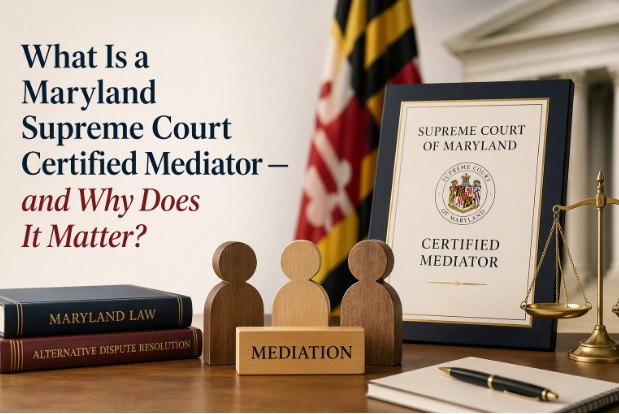
A Maryland Supreme Court-certified mediator is a dispute resolution professional who has met the credentialing standards established by the Maryland court system and carries credentials verifiable through a public government database before you hire anyone.
Not every mediator who uses the word “certified” has met the court’s standards. Understanding what the credential actually requires protects you from the moment you schedule the first session.
Don Saunders, founder of Saunders Mediation Services, is a Supreme Court-certified mediator and Florida Court Accredited Mediator serving families and businesses throughout Annapolis and Anne Arundel County.
Key Takeaways
Maryland Supreme Court-certified mediator status requires completing a 40- to 50-hour foundational training program that meets Title 17 of the Maryland Rules, plus documented case experience and continuing education each year.
A training certificate of completion is not the same as court certification — a practitioner who finishes a weekend mediation course receives a certificate, but only mediators who satisfy the court’s approval process qualify for the circuit court roster.
The Maryland Program for Mediator Excellence (MPME), a program of MACRO, maintains a public mediator directory where consumers can verify a mediator’s credentials before hiring.
Maryland has no universal statewide licensing requirement for private mediators, making voluntary credentialing through the MACRO framework the clearest signal of professional accountability available to consumers.
Hiring a court-certified mediator means your mediator has agreed to abide by the Maryland Standards of Conduct for Mediators and to complete continuing education every year.
What Does “Maryland Supreme Court Certified” Actually Mean?
Maryland Supreme Court-certified mediator status describes a practitioner who has met the qualifications under Title 17 of the Maryland Rules of Procedure and gained approval to serve on a circuit court ADR roster — so you can search the MACRO mediator directory at mdcourts.gov and confirm the credential is genuine before committing to any process.
The phrase appears on many mediator websites. The precise meaning depends entirely on which process the mediator has actually completed.
Maryland’s court-certification framework is governed by Title 17 of the Maryland Rules of Procedure, which sets the qualifications and responsibilities for mediators designated to conduct ADR in the circuit courts. A mediator approved to serve on a circuit court roster has satisfied the court’s formal credentialing threshold for practitioners in Maryland.
The mediator excellence program adds a second, voluntary layer. MPME membership, administered by MACRO and launched in August 2006, requires a mediator to complete at least ten hours of continuing education per year, maintain two of those hours as ethics-specific training, abide by the Maryland Standards of Conduct for Mediators, and participate in good faith with the Mediation Ombuds Program.
MPME members appear in the public MACRO directory by name, location, and practice area.
Maryland’s absence of a statewide licensing requirement is precisely why court certification and MPME membership function as the primary consumer protection signals available to prospective clients.
Any practitioner may call themselves a mediator and accept payment without completing a single hour of training. The MACRO framework is the most reliable external verification tool for anyone evaluating a mediator in Maryland.
If you are ready to work with a Supreme Court-certified mediator in Annapolis, schedule a consultation with Saunders Mediation Services today.
If you’re ready to get
started, call us now!
The MACRO Framework: How Maryland Courts Oversee Mediator Quality
MACRO — the Maryland Judiciary Mediation and Conflict Resolution Office — is the government body that approves circuit court mediators, maintains the public mediator directory, and sets the professional standards Maryland mediators must follow.
Consumers use MACRO’s searchable directory to verify any mediator’s credentials before hiring, so professional standing is confirmed through a government source rather than a mediator’s self-description alone.
MACRO Function
What It Means for Consumers
Circuit Court Roster
Mediators on this list have met Title 17 qualifications and are approved for court-referred cases
MPME Membership
Members commit to 10 continuing education hours per year and adhere to the Maryland Standards of Conduct
Public Mediator Directory
Searchable at mdcourts.gov — confirms a mediator’s listed status before you hire
Mediation Ombuds Program
Provides a formal process to address concerns about a mediator’s conduct
Maryland Standards of Conduct
Adopted in 2006, these standards govern neutrality, confidentiality, and professional behavior for all MPME members
On July 1, 2025, rule changes to Title 17 revised the ADR roster application process, requiring practitioners to apply directly to MACRO through a centralized online platform rather than submitting separate applications to each individual circuit court. MACRO now oversees approval for all circuit and orphans’ court ADR rosters statewide.
For consumers, that centralization matters: one authoritative source — the MACRO directory — now reflects approved mediators across Maryland, making credential verification faster and more reliable than at any prior point in the state’s ADR history.
What a Court-Certified Mediator Has Actually Completed
Maryland’s circuit court roster requires a 40- to 50-hour basic mediation training program satisfying the substantive requirements of Title 17, so you know the training covers the legal and procedural context specific to mediation vs litigation in Maryland, not a generic national curriculum.
The Title 17 training must cover conflict resolution theory, mediation skills and techniques, mediator conduct including ethics and confidentiality, and simulated role-play sessions monitored by experienced mediators.
Mediators applying for specialty practice areas must complete additional documented hours beyond the foundation:
Practice Area
Additional Training Required
Child Custody and Visitation
20+ hours specialty training; 8+ hours co-mediation in child access cases under Rule 9-205
Marital Property / Financial Issues
20+ hours training in financial issues related to divorce and annulment under Rule 17-205(c)
Business and Technology Cases
Advanced training and demonstrated experience in the relevant field under Rule 17-205(b)
Health Care Malpractice
Specialty training per Rule 17-205(b) and documented subject-matter experience
Ongoing Annual Requirement — Circuit Court Roster
Minimum 4 continuing education hours per year
Ongoing Annual Requirement — MPME Members
Minimum 10 continuing education hours per year, including 2 ethics hours
MPME members commit to a higher annual standard than the circuit court minimum — at least ten hours of continuing education, two of which must address ethics. The ongoing commitment is what separates MPME membership from a one-time credential.
MCDR developed its performance-based assessment rating scale in 1994 and began certifying Maryland mediators based on nine core competencies across three practice domains: process management, content management, and participant relationship management.
MCDR has held Qualifying Assessment Program recognition from the International Mediation Institute since 1998, making MCDR certification one of eight IMI-recognized programs in the United States.
Why This Matters Before You Hire a Mediator in Maryland
Maryland’s lack of universal licensing creates a significant information gap. A practitioner with a weekend certificate and one who has satisfied Title 17, holds MPME membership, and has mediated hundreds of cases can both describe themselves as “certified mediators” — so you need specific questions to tell the difference before committing to a process that will shape your family mediation outcome, your business mediation resolution, or your civil case settlement.
Are you listed on the MACRO Mediator Directory? A yes to this question means the mediator’s court credential status is publicly verifiable on a government platform — so you can confirm professional standing before signing any agreement, rather than relying solely on website copy.
Have you completed the Title 17 training requirements? Title 17 training covers the specific legal and procedural context of Maryland dispute resolution, including mediation confidentiality protections under Rule 17-105, which protect all mediation communications from disclosure in any judicial or administrative proceeding — so you know what you say in the session stays confidential.
Are you an MPME member? MPME membership signals a commitment to the Maryland Standards of Conduct and to annual continuing education, so you have a formal accountability mechanism through the Mediation Ombuds Program if a concern ever arises about how your session was handled.
What is your experience in cases like mine? Court certification covers general competency, but specialty areas — custody mediation, divorce mediation, and workplace conflicts — require additional documented training beyond the base qualification, so ask specifically about case volume in your dispute category before hiring.
Do you hold dual-state credentials? A mediator holding both Maryland credentials and accreditation in another jurisdiction can serve clients in multi-state disputes without requiring separate practitioners in each state, so you avoid duplicating costs and coordinating between two separate neutral parties.
To determine whether Don Saunders’s credentials and experience align with your dispute, schedule a free consultation with Saunders Mediation Services in Annapolis.
If you’re ready to get
started, call us now!
The Difference Between Certified, Trained, and Accredited
These three terms appear interchangeably on mediator websites but describe distinct levels of qualification. The difference between a training certificate and verified court credentialing is meaningful when the outcome of your mediation agreement may determine how your family, business, or estate moves forward.
Term
What It Typically Means
Verification Source
Trained
Completed a foundational mediation training program; received a certificate of completion
Mediator self-report; training organization records
Certified
Met the evaluation criteria of a specific certifying body — MCDR, CMM, or ISCT in Maryland — through performance-based or experience-based assessment
Certifying an organization’s membership or registry
Court-Approved / Roster
Satisfied Title 17 requirements and approved by MACRO for circuit court ADR referrals
MACRO Mediator Directory at mdcourts.gov
MPME Member
Voluntarily committed to MPME standards — 10 continuing education hours per year, ethics training, Maryland Standards of Conduct
MACRO Mediator Directory
Accredited (Florida)
Met the Florida Supreme Court’s ADR accreditation standards for private mediators
Florida Dispute Resolution Center registry
A self-described “certified mediator” who cannot point to a verifiable registry listing — MACRO, MCDR, or a state accreditation body — has completed a training program, not a credentialing process. A training certificate and court certification under Title 17 are not equivalent.
What Don Saunders’s Credentials Mean for Annapolis Clients
Don Saunders founded Saunders Mediation Services after more than four decades of business leadership — 14 years as Vice President of Consumer Lending at Dominion Bankshares Corporation, followed by founding and growing Saunders Landscape Supply into a multi-million-dollar enterprise sold in 2022.
His business background is the professional context that makes him particularly effective in business mediation and commercial disputes, where parties need a mediator who has personally managed payroll, vendor contracts, multi-million-dollar sale negotiations, and the operational decisions that litigation puts at risk — so you get a mediator who understands the financial stakes, not just the facilitation process.
Saunders holds Supreme Court-certified mediator status and Florida Court-accredited mediator status.
His dual-state credentials are particularly relevant for clients with ties to both states — business owners operating across Maryland and Florida, families managing assets or relocating, or probate mediation matters where one party resides in Florida and the other in Maryland — so you resolve multi-state disputes through a single qualified neutral rather than coordinating separate practitioners in each jurisdiction.
What is a Maryland Supreme Court-certified mediator?
A Maryland Supreme Court-certified mediator is a dispute resolution professional who has satisfied the credentialing standards established by the Maryland court system and is approved to conduct court-referred ADR under Title 17 of the Maryland Rules.
Is mediation certification required to practice in Maryland?
Maryland requires no statewide mediator license for private practitioners. Mediators seeking court referrals must satisfy Title 17 qualifications and gain MACRO approval. Private mediators may operate without that approval, which is why independent credential verification matters before hiring.
What is the MPME, and what does MPME membership mean for clients hiring a mediator?
The MPME is MACRO’s voluntary excellence program that requires members to complete 10 continuing education hours per year, including 2 ethics hours, and to abide by the Maryland Standards of Conduct. Membership signals ongoing professional accountability to prospective clients.
How is a training certificate different from a court certification in Maryland?
A training certificate documents completion of a foundational mediation course. Court certification additionally requires documented case experience, agreement to the Maryland Standards of Conduct, annual continuing education, and approval by the Maryland court system. The two credentials are not equivalent.
Can a mediator hold certification in both Maryland and Florida?
Yes. Maryland court credentials and Florida Supreme Court ADR accreditation are issued by separate bodies under different state standards. A mediator who holds both can handle multi-state disputes without requiring separate practitioners in each jurisdiction.
What does MACRO stand for in Maryland mediation?
MACRO stands for the Maryland Judiciary Mediation and Conflict Resolution Office. MACRO oversees the circuit court ADR roster, administers the MPME, maintains the public mediator directory, and sets standards for court-referred dispute resolution statewide.
How do I verify a Maryland mediator’s credentials before hiring?
Search the MACRO Online Mediator Directory at courts.state.md.us/macro/mediatordirectory by mediator name, county, and case type. For MCDR-certified mediators, contact the Maryland Council for Dispute Resolution directly to confirm membership.
Where is Saunders Mediation located, and what areas does it serve?
Saunders Mediation Services, LLC is located at 722 Coybay Drive, Annapolis, Maryland 21401, serving all of Anne Arundel County and Maryland statewide. Dual-state credentials cover multi-state matters involving Florida parties.