Divorce Mediation in Annapolis: What Maryland Couples Need to Know Now
Originally published: July 2025 | Updated: July 2026 | Reviewed by Don Saunders
Divorce mediation lets Annapolis couples end a marriage through guided negotiation rather than courtroom conflict, using Saunders Mediation’s family mediation services to settle custody, support, and property terms in a fraction of the time it takes litigation.
Maryland’s 2023 legal reform simplified divorce grounds statewide, making mediation an even more direct path to a signed settlement.
Key Takeaways
Maryland eliminated fault-based divorce grounds and limited divorce entirely as of October 1, 2023, under Md. Code, Family Law § 7-103.
Couples now qualify for absolute divorce by mutual consent, after six months of pursuing separate lives, or due to irreconcilable differences — there is no separate “signed agreement” ground.
Mediation sessions in Annapolis typically run $150–$350 per hour, with most couples reaching a signed agreement in two to five sessions.
A mediated agreement becomes enforceable once both spouses sign it and, where applicable, the court incorporates it into the final divorce decree.
Don’t let a drawn-out court calendar decide your family’s future. Saunders Mediation helps Annapolis spouses reach a fair settlement — schedule a confidential consultation today.
What Is Divorce Mediation and How Does It Work in Annapolis?
Divorce mediation is a voluntary, confidential process in which a neutral mediator helps spouses negotiate their own settlement terms rather than having a judge decide. The mediator does not represent either spouse and cannot force an outcome; both parties retain full control over the final terms, and either spouse can end the process at any point if it isn’t working.
In Annapolis, sessions typically follow the same intake-to-settlement sequence regardless of which mediator a couple chooses: an initial consultation, followed by structured negotiation sessions covering parenting, support, and property, and ending in a written settlement that can be filed with the court.
Spouses may attend jointly or in separate rooms if the mediator uses caucusing to manage a high-conflict moment, which is common when Don Saunders — a Supreme Court-Certified Mediator with more than 30 years of experience in family, business, civil, and probate matters — works with couples who are still processing raw emotion early in the step-by-step mediation process.
What Are the Legal Grounds for Divorce in Maryland Now?
Maryland’s divorce grounds changed substantially under Senate Bill 36, effective October 1, 2023, and the older framework of adultery, desertion, and multi-year separation no longer applies to any case filed after that date.
Couples filing today have three paths to an absolute divorce, and Maryland no longer recognizes limited divorce (legal separation) as a court status.
Ground
Requirement
Notes
Mutual consent
Both spouses sign a written settlement agreement resolving custody, support, and property
No waiting period required
Six-month separation
Spouses have “pursued separate lives” for six months without interruption
Applies even if still under the same roof
Irreconcilable differences
One spouse states the marriage cannot be repaired
No separation period required
Fault-based conduct such as adultery or cruelty is no longer a divorce ground itself, but under Md. Code, Family Law § 7-103, courts can still weigh that conduct when deciding alimony, custody, or a monetary property award.
Couples should confirm which ground applies to their situation, since the reform does not apply retroactively to cases filed before October 1, 2023.
If you’re ready to get
started, call us now!
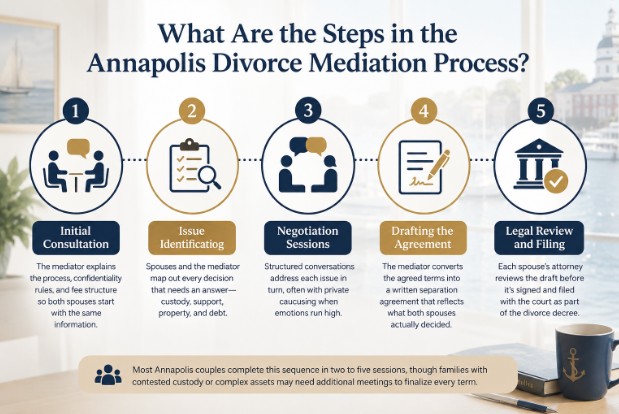
What Are the Steps in the Annapolis Divorce Mediation Process?
Mediation follows a defined sequence, and understanding each stage helps couples set realistic expectations before their first session.
Initial consultation: The mediator explains the process, confidentiality rules, and fee structure so both spouses start with the same information.
Issue identification: Spouses and the mediator map out every decision that needs an answer — custody, support, property, and debt.
Negotiation sessions: Structured conversations address each issue in turn, often with private caucusing when emotions run high.
Drafting the agreement: The mediator converts the agreed terms into a written separation agreement that reflects what both spouses actually decided.
Legal review and filing: Each spouse’s attorney reviews the draft before it’s signed and filed with the court as part of the divorce decree.
Most Annapolis couples complete this sequence in two to five sessions, though families with contested custody or complex assets may need additional meetings to finalize every term.
How Much Does Divorce Mediation Cost Compared to Litigation in Annapolis?
Mediation costs less than contested litigation in the vast majority of Annapolis cases because both spouses share a single neutral professional rather than paying two separate attorneys for every motion and hearing.
Factor
Divorce Mediation
Contested Litigation
Typical hourly rate
$150–$350 (shared)
Separate attorney fees per spouse
Sessions/timeline
2–5 sessions, often weeks
Months to over a year
Decision-maker
Both spouses
A judge
Privacy
Confidential
Public court record
Couples reviewing realistic cost ranges for their own situation should factor in whether children, business interests, or retirement accounts are involved, since those specifics typically add sessions rather than dramatically increasing the hourly rate.
Three factors most often extend both cost and timeline: contested custody arrangements, business or investment property requiring valuation, and disagreements over the division of a retirement account.
Couples who enter mediation with financial documentation already organized tend to finish faster and spend less per session than those still gathering records mid-process.
Sorting out a jointly owned rental property or a defined-benefit pension typically adds an entire additional session, since the mediator often recommends a neutral appraisal before either spouse can meaningfully negotiate a fair split.
Annapolis couples with straightforward finances and no real estate beyond the marital home tend to land at the lower end of the cost range, while those with a business or multiple properties should budget for the higher end.
Draining your savings while losing control of the outcome doesn’t have to be the trade-off. Schedule a confidential consultation with Saunders Mediation.
How Should You Prepare for a Divorce Mediation Session?
Preparation shapes how productive each session becomes, and spouses who arrive organized typically resolve issues faster than those working from memory alone.
Gather financial documents: tax returns, pay stubs, bank statements, and retirement account summaries.
List priorities in advance, separating must-have terms from points open to compromise.
Bring a parenting schedule outline if children are involved, even a rough draft.
Note any private concerns for the mediator, including safety issues that may affect how sessions are structured.
Couples weighing mediation versus litigation often find that this preparation step is what actually shortens the timeline, not the mediator’s process itself.
If you’re ready to get
started, call us now!
How Do You Choose the Right Divorce Mediator in Annapolis?
A mediator’s credentials and approach directly affect how smoothly negotiations go, particularly in emotionally difficult cases. Look for someone certified through Maryland’s Mediation and Conflict Resolution Office, listed on the state’s MACRO mediator directory, with specific experience in family and divorce matters rather than general civil disputes.
Strong communication skills, neutrality, and emotional steadiness matter as much as years of experience.
A mediator who can keep both spouses talking productively, without appearing to favor either side, tends to produce more durable agreements than one focused purely on efficiency.
Couples can also cross-check credentials through Saunders Mediation’s mediator directory guide before committing to a session.
What Happens After Mediation Ends, and Is the Agreement Binding?
A mediated agreement becomes enforceable once both spouses sign it, and it typically gains full legal force once the court incorporates it into the final judgment of absolute divorce. Spouses should still expect several practical steps once sessions conclude:
Each spouse’s attorney reviews the signed terms before filing.
The agreement is submitted to the court along with the divorce complaint.
Child-related terms remain subject to court modification if circumstances change materially.
Financial and property terms generally hold as written, absent fraud or coercion.
Couples wondering what to expect after mediation ends can review the full follow-up sequence, including how long it typically takes for court approval in Anne Arundel County.
Contact Us Today For An Appointment
Frequently Asked Questions
Is divorce mediation required in Maryland, or can couples choose it themselves?
Mediation isn’t automatically required for every Maryland divorce, though courts often order it for contested custody or parenting disputes. Couples can also choose private mediation voluntarily, before or after filing, to resolve support, property, and parenting terms without a judge deciding.
How has Maryland’s 2023 law change affected divorce grounds?
Since October 1, 2023, Maryland eliminated fault-based grounds and limited divorce entirely, replacing the older adultery, desertion, and multi-year separation categories. Couples now qualify through mutual consent, six months of pursuing separate lives, or irreconcilable differences, with no separation requirement for the last two paths.
Do spouses still need lawyers if they use a mediator?
Yes. Most mediators recommend each spouse have independent legal review before signing, since a mediator remains neutral throughout the process and cannot advise either party on their individual legal rights, explain how Maryland law applies to their case, or draft enforceable settlement language on their behalf.
How many mediation sessions does divorce typically take in Annapolis?
Most Annapolis couples complete divorce mediation in two to five sessions, depending on how complex their finances are and how far apart they start on parenting schedules and property division. Contested custody disputes or business valuations often require additional sessions to finalize every term.
Can mediation address child custody and parenting plans?
Yes. Mediators guide spouses through custody schedules, decision-making authority, and holiday arrangements, producing a written parenting plan that can be incorporated into the final divorce decree alongside financial terms, giving both parents a clear reference document going forward.
What happens if spouses can’t agree on every point in mediation?
Mediation can resolve some matters while leaving others for litigation. Many couples settle straightforward terms, like routine property division, through mediation and only take genuinely contested custody or support questions to court, which narrows what a judge ultimately has to decide.
Is a signed mediation agreement legally binding immediately?
Under Maryland law, a signed agreement is generally binding as a contract, but full court enforceability usually requires filing it with the divorce case or having it incorporated into a consent order, particularly for child-related terms that remain subject to judicial review.
Does living under the same roof disqualify a couple from the six-month separation ground?
No. Maryland law now allows spouses who have “pursued separate lives” to qualify for six-month separation even while residing in the same home, as long as they maintain separate finances, routines, and daily living arrangements that reflect a genuine intent to end the marriage.
How does mediation protect privacy compared to a court divorce?
Mediation sessions are confidential and don’t become part of the public record the way courtroom testimony and filings do. Only the final settlement agreement, once filed with the court as part of the divorce case, becomes part of the public court file.
Can mediation help with asset division and alimony at the same time?
Yes. Mediators routinely address property division and spousal support in the same sessions, since the two topics often affect each other financially — a larger property settlement can reduce the need for alimony, for example. Couples can negotiate both simultaneously rather than through separate proceedings.
You don’t have to face this alone or let a courtroom schedule dictate your timeline. Reach out to Saunders Mediation for a confidential consultation.