Mediation vs. Arbitration vs. Litigation in Maryland: Pros, Costs & When to Use Each
Originally published: November 2025 | Updated: March 2026 | Reviewed by Don Saunders
When business disputes arise in Maryland, small business owners must decide on a course that could significantly impact their company’s future.
Perhaps a client has missed a payment, a contract dispute has flared up with a supplier, or a partnership disagreement is threatening to spiral out of control.
Maryland small businesses generally face three paths to resolve disputes. Mediation is usually the fastest and least costly (especially through court ADR).
Arbitration is private and faster than most court cases, but adds forum and arbitrator fees. Litigation offers the broadest court powers and appeals, but typically takes the longest and costs the most.
Many business owners assume that court litigation is their only option when conflicts escalate.
However, mediation and arbitration provide structured methods for resolving disputes outside the court system, often saving time and money.
Each method fits different business needs and types of disputes. Knowing how they stack up in terms of cost, timeline, and outcomes can help Maryland entrepreneurs make smarter choices that actually protect their bottom line.
The decision between collaborative problem-solving, private binding decisions, or public court battles can determine whether a business emerges stronger or struggles to recover from a dispute.
Key Takeaways
Mediation is the fastest and most cost-effective option, but it requires mutual agreement on the outcome.
Arbitration gives you a binding decision in private, but it can be expensive, and appeals are tough.
Litigation means enforceable judgments and legal precedent, but it’s slow, costly, and public.
What Maryland Small Business Owners Really Ask
Maryland business owners face some tough decisions when business disputes arise. Legal jargon can be overwhelming, and the fear of making a mistake is real.
“Will this destroy my business relationship?” That question comes up all the time. Most owners worry that formal legal action will nuke partnerships or client ties for good.
“How much will this actually cost me?” Hidden fees and endless bills are a big worry. Owners want straight answers about the total cost, not just the hourly rate.
“How long before I can focus on my business again?” Every day spent on a dispute means less time for actual business. They want honest timelines for each dispute resolution method.
“What if I lose everything?” This fear drives a lot of questions. Business owners worry that a legal battle could sink them.
“Can I keep this private?” Sensitive info is at stake in many disputes. Confidentiality is crucial, so owners often inquire about privacy in alternative dispute resolution.
“Do I really need a lawyer?” Some wonder whether they can handle disputes on their own or if professional help is necessary.
“Which option gives me the best chance to win?” Winning means different things to different businesses. Some want total victory, others just want to move on.
All these questions really just show how much business owners care about surviving and maintaining their sanity.
Table: Speed–Cost–Control Quick Comparison
Path
Typical Speed
Direct Costs
Privacy
Enforceability
Appeal Rights
Best For
Mediation
Days to weeks (often same-day via court ADR)
Free through court ADR; private varies
Confidential
Settlement agreement
No appeals; enforced as a contract
Preserving relationships, flexible terms
Arbitration
Months (often faster than court)
Arbitrator + forum fees + attorney time
Private
Binding award
Very limited
Contracted disputes needing finality
Litigation
District Court ≈4–6 months; Circuit Court can exceed 1 year
Filing fees + $200–$500/hr attorneys
Public record
Court judgment
Full appeals allowed
High-stakes cases, injunctions, precedent
Mediation In Maryland: Fastest Path To Practical Solutions For Small Businesses
Maryland’s mediation system provides small businesses with the quickest way to resolve disputes. Court programs and private mediators make this possible.
Owners usually see faster results, pay less, and keep more control over the outcome than if they go to court. That’s a significant concern when time and money are scarce.
How District Court ADR Works For Maryland Small Businesses
Maryland District Courts provide ADR (often mediation) for civil disputes. After referral or agreement, a trained neutral facilitator leads a confidential session (typically 2–4 hours).
Many matters are resolved in a single session. Written settlements are enforceable as contracts under Maryland law.
The process begins when both parties agree to mediation or a court refers them to it. A trained neutral third party leads the conversation and helps both sides discuss their concerns.
Sessions usually last 2–4 hours. Sometimes, you solve the whole thing in one meeting.
Maryland has strong confidentiality rules for court-referred mediation under Judiciary Rule Title 17. The Maryland Mediation Confidentiality Act covers other cases.
Business owners can pick mediators with the right industry background. The mediator helps find common ground, but doesn’t force a decision.
When Mediation Is Ideal For Business Disputes
Mediation shines when you want to keep working with the other side after the dust settles. Contract arguments, partnership fights, and supplier headaches are all good fits.
Prime Mediation Scenarios:
Contract interpretation disputes
Payment fights under $30,000
Partnership or LLC member clashes
Vendor delivery or quality issues
Employment disputes with key staff
Small businesses really value mediation when relationships matter more than just “winning.” It keeps bridges from burning that litigation might torch.
Disputes that require a prompt response also fall under this category. Mediation typically concludes within 30–90 days, whereas court cases can last for over a year.
Mediation only works if both sides show up ready to talk. If someone’s hiding something, committing fraud, or just refuses to negotiate, mediation falls flat.
Outcomes And Enforceability Of Mediation Agreements
If mediation is successful, you will have a settlement agreement that becomes legally binding once everyone has signed. Maryland courts treat these agreements like any contract.
Settlement Agreement Components:
Clear payment terms and deadlines
Rules for future business together
Confidentiality promises
Performance checkpoints
Ways to enforce the deal
People can be creative in mediation—perhaps a new payment plan, a future discount, or a service change that works for both parties. Courts typically do not offer those options.
Maryland law requires a written agreement for it to be enforceable. If you simply discuss it and don’t put it in writing, it’s not binding.
Business mediation in Maryland succeeds 70–85% of the time. If it fails, you can still go to court, and nothing you said in mediation gets used against you.
If one party breaches the agreement, the other side may file a breach of contract claim. Regular contract law covers enforcement.
Limits Of Mediation For Maryland Small Businesses
Mediation doesn’t fix every business dispute. Some legal and practical limits get in the way.
When Mediation Fails:
Someone refuses to negotiate in good faith
You need to set a legal precedent
There’s criminal fraud or theft
You need a court order right away
One side has way more power than the other
When more than three or four parties are involved, mediation gets complicated fast. It’s hard to get everyone on the same page.
Mediation doesn’t let you dig for evidence. If you need documents from the other side, you’re better off in court or arbitration.
The neutral third party can’t force anyone to hand over records or testify. That can be a problem if one side knows way more than the other.
Sometimes, you need a public result to send a message or stop bad business practices. Mediation keeps everything private, so it doesn’t set an example.
Attorneys typically see mixed results, depending on the case and the level of preparation by all parties. If you walk in unprepared or expect miracles, mediation is unlikely to be effective.
For Maryland small businesses comparing mediation, arbitration, or litigation, Saunders Mediation provides clarity and direction to move forward. Don’t delay—contact us for guidance today.
If you’re ready to get
started, call us now!
Arbitration In Maryland: Private, Binding, And Watch The Fine Print
Arbitration in Maryland follows specific state laws that small business owners should be aware of before signing any agreements.
The arbitration process becomes binding once you agree to it, and backing out later is nearly impossible.
When Arbitration Is Used In Maryland Small Business Contracts
Small businesses in Maryland often encounter arbitration clauses in vendor, partnership, and employment agreements.
Arbitration clauses in contracts mean you have to resolve fights with a private arbitrator, not a judge.
You’ll see these clauses in:
Software licensing agreements
Equipment leases
Partnership agreements
Employment contracts
Franchise agreements
Many business owners sign contracts without carefully reading the arbitration sections. The wording looks harmless, but it matters.
When a dispute comes up, you might realize you can’t just take it to court. You’re locked into the arbitration process outlined in your contract.
Some contracts name a specific arbitration organization, such as the American Arbitration Association (AAA) or JAMS. Others leave it up to both sides to figure out later.
Timing Rules And Statutory Nuances In Maryland Arbitration
Arbitration timing is driven by your contract and the administrator’s rules (e.g., AAA/JAMS). Maryland courts can compel arbitration when a valid clause exists and may stay court litigation pending arbitration.
There is no universal 30-day filing rule—use the deadlines in your agreement or governing rules.
Parties typically have 30 days to demand arbitration after a dispute arises. Miss that deadline, and you might lose the right to arbitrate altogether.
The arbitration process typically lasts 3-6 months from start to finish. Of course, that depends on how complicated the case is and whether the arbitrator’s got a packed schedule.
Key Maryland timing rules:
Stage
Typical Timeframe
Initial filing
30 days from dispute
Arbitrator selection
2-4 weeks
Discovery period
30-60 days
Hearing scheduled
60-90 days
Final decision
30 days after hearing
Maryland courts will compel arbitration if one party attempts to avoid it. They can also pause court cases if arbitration is used instead.
Cost Drivers Of Arbitration For Small Businesses
Arbitration costs often catch small business owners off guard. People expect it to be cheaper than going to court, but the fees pile up quickly.
Administrative fees from groups like AAA or JAMS range from $1,500 to $8,000, depending on the claim size. These fees cover expenses such as case management and scheduling.
Arbitrator fees typically range from $300 to $ 800 per hour. A straightforward case typically requires 20-30 hours of the arbitrator’s time, while a complex case can consume 100+ hours.
Small businesses also pay their own lawyers, and those fees often look a lot like what you’d pay in court. Arbitration’s confidentiality means attorneys can’t lean on public case law as much.
Total cost breakdown for a $100,000 dispute:
Administrative fees: $3,500
Arbitrator costs: $15,000-25,000
Attorney fees: $20,000-40,000
Expert witnesses: $5,000-15,000
These numbers sometimes exceed what small business owners would spend if they were to go to court.
Risks Of Arbitration For Maryland Small Businesses
Arbitration awards are binding, which can be a risk for small businesses. Once the arbitrator decides, it’s almost impossible to appeal.
Maryland courts overturn arbitration awards only in rare cases, such as fraud or arbitrator misconduct. You can’t appeal simply because you dislike the result.
Confidentiality keeps business problems out of the public eye, but it also means others can’t learn from your experience. That secrecy might actually hurt small businesses dealing with repeat offenders.
The arbitrator selection process often favors larger companies that are familiar with the system. They tend to know which arbitrators lean their way.
Small businesses sometimes encounter arbitrators who lack in-depth knowledge of their industry. Unlike judges who see all kinds of cases, some arbitrators focus on areas that have nothing to do with your dispute.
The informal nature of arbitration can trip up businesses that need strict evidence rules. Arbitrators allow testimony and documents that courts might block.
Litigation In Maryland: When Court Power And Precedent Matter For Small Businesses
Maryland courts give small businesses formal legal procedures and binding decisions. The state’s court system offers various venues based on the size and complexity of the claim.
District Vs Circuit Court Basics For Small Businesses
Small Claims (≤ $5,000, money only) proceed in District Court with simplified procedures. Other civil matters up to $30,000 are in District Court (with some limits), while higher-value or equitable matters are in Circuit Court, with broader discovery and full appellate rights.
The Circuit Court handles business disputes exceeding $5,000. These cases become more formal and typically require the assistance of an attorney.
The Circuit Court also hears disputes over contracts, partnership dissolutions, and employment issues.
Table: Maryland Jurisdiction & Process Snapshot
Item
Small Claims (District)
District Court (General Civil)
Circuit Court
Typical Claim Value
≤ $5,000 (money only)
Up to $30,000
> $30,000 or equitable/complex
Formality
Simplified
Moderate
Highest
Discovery
Very limited
Limited
Full discovery
Timeline (typical)
1–3 months
~4–6 months+
12–24 months+
Appeal
Limited
To Circuit (in some cases)
To the Appellate Court
Litigation Timelines In Maryland Courts
Litigation timelines in Maryland swing wildly depending on the court. District Court cases typically conclude within 3-6 months from filing to judgment. Circuit Court cases, on the other hand, can last 12-24 months or even longer.
Small claims in District Court move the fastest. Most get scheduled within 30-60 days after filing. The actual hearing? Sometimes just 15-30 minutes.
Complex business disputes in Circuit Court take longer. Discovery alone can last 6-12 months, and pre-trial wrangling adds more time.
Typical Maryland Litigation Timeline:
Filing to first hearing: 30-90 days
Discovery phase: 3-12 months
Trial preparation: 2-6 months
Final resolution: 6 months to 2+ years
Cost Of Litigation For Maryland Small Businesses
Litigation costs in Maryland depend on the court and the complexity of the case. District Court filing fees range from $15 to $34 for small claims. Circuit Court filing fees start around $165 for civil cases.
Attorney fees consume the largest portion for most small businesses. Maryland lawyers typically charge $200-$500 per hour for business litigation.
Simple cases total $2,000-$5,000. Complex disputes can rocket up to $25,000-$100,000 or more.
Other costs include court reporters, expert witnesses, and the costs of discovery. Those fees tack on another $1,000-$10,000, depending on the case.
Maryland Litigation Cost Breakdown:
Cost Category
District Court
Circuit Court
Filing Fees
$15-$34
$165+
Attorney Fees
$1,000-$5,000
$5,000-$50,000+
Other Costs
$100-$500
$1,000-$10,000
When Litigation Is Unavoidable For Maryland Small Businesses
Some business disputes just need litigation. Maryland small businesses often seek injunctive relief in court to prevent a competitor from causing harm.
Debt collection often ends up in court. Maryland businesses must follow specific steps if customers refuse to pay after repeated attempts. Court judgments give legal teeth to garnish wages or grab assets.
Contract breaches with significant damages usually result in litigation. Courts can order damages and enforce contract terms that mediation or arbitration can’t touch.
Business owners also need a court when dealing with fraud. Criminal fraud is handled by law enforcement, but civil fraud claims require the courts to recover money and establish legal precedent.
Litigation is necessary when businesses need:
Court orders to stop competitor interference
Debt collection through wage garnishment
Contract enforcement with specific performance
Fraud recovery with punitive damages
In Maryland, Saunders Mediation provides small businesses with practical dispute resolution solutions that avoid lengthy court battles. Save time and reduce costs now—contact us to learn more.
If you’re ready to get
started, call us now!
Decision Framework: Choosing The Right Path For Your Maryland Small Business
Maryland small business owners really need a clear process for picking the best way to resolve a dispute.
The right choice depends on business relationships, weighing costs against risks, and ensuring contracts have the right language from the outset.
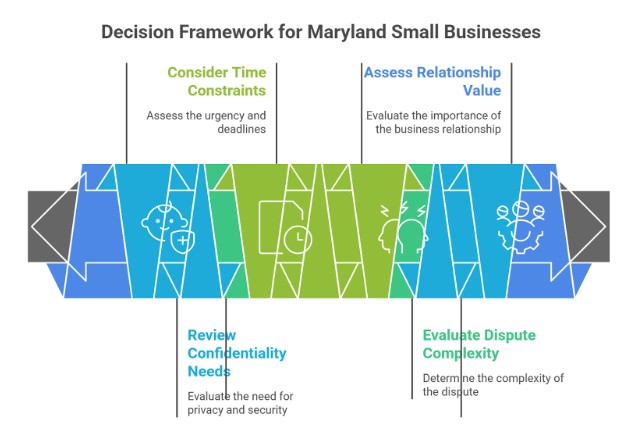
Step-By-Step Decision Flow For Maryland Small Businesses
Owners should begin by examining the nature of the dispute and their relationship with the other party.
If they want to keep the relationship going, mediation offers the best chance for a collaborative solution.
Step 1: Assess Relationship Value
Ongoing partnership or vendor relationship → Consider mediation first
One-time transaction or burned bridge → Arbitration or litigation might be better
Step 2: Evaluate Dispute Complexity
Simple contract disagreements → Mediation or arbitration
Complex legal issues needing precedent → Litigation might be the only way
Step 3: Consider Time Constraints
Need a fast answer → Mediation (weeks) or arbitration (months)
Can wait for a thorough process → Litigation (1-3 years)
Step 4: Review Confidentiality Needs
Private matters → Mediation or arbitration
Public accountability matters → Litigation creates a public record
Business owners should review their contracts for dispute resolution clauses that could limit their options. Picking the right path depends on the details of each dispute.
Relationship And Reputation Considerations In Dispute Resolution
Business relationships often steer which dispute resolution method works best for Maryland small businesses. Mediation’s great for saving partnerships because both sides work together to find a solution.
For companies with ongoing contracts or shared customers, mediation allows them to resolve problems without burning bridges. That collaborative vibe helps maintain trust and communication.
High-Relationship-Value Situations:
Long-term supplier agreements
Joint ventures
Franchise relationships
Industry networking connections
Arbitration is a suitable option when relationships are rocky, but nobody wants a public court battle. The private process keeps reputations intact while delivering a binding decision.
Litigation makes sense when relationships are already toast. Sometimes, public court action sets boundaries and shows other potential partners what your standards are.
Maryland small businesses should carefully consider how their choice of dispute resolution will impact their standing in the local business community. Word gets around fast.
Cost-Benefit Analysis: Fees Now Vs Risk Later
Smart business owners compare what they’ll pay now to settle a dispute against what it could cost them down the road.
Mediation typically costs $2,000-$5,000, but it can save significantly by preserving business relationships.
Arbitration fees range from $5,000 to $25,000, depending on the complexity of the matter. Still, that’s often cheaper than litigation, which can easily top $50,000 for a tough business dispute.
Table: Cost Drivers by Path
Path
Primary Cost Drivers
How to Reduce Cost
Mediation
Neutral’s fee (if private), brief prep, limited counsel time
Court ADR, prepare term sheet, and decision-maker attendance
Arbitration
Filing/admin fees, arbitrator hourly, limited discovery, counsel time
Narrow issues, choose a single arbitrator, and agree on deadlines
Early case management order, targeted discovery, and early settlement conference
Maryland businesses should also consider the hidden costs, such as the management time lost to disputes. Long court battles pull owners away from actually running the business.
The “risk later” part refers to potential damage to relationships, lost contracts, and missed opportunities. Sometimes, paying more up front for a quick fix is the smarter move.
Checklist: Key ADR Contract Clauses For Maryland Small Businesses
Maryland small businesses really need clear language in their contracts for smooth dispute resolution. Well-written dispute-resolution clauses can prevent a lot of confusion and delays when issues arise.
Essential Clause Elements:
Mandatory mediation first – Requires good-faith mediation before other methods
Arbitration rules – Specify American Arbitration Association or other organization
Location requirements – Name Maryland City for proceedings
Timeline limits – Set deadlines for initiating dispute resolution
Sample Mediation Clause: “Any dispute shall first be addressed through mediation in Baltimore County, Maryland, within 60 days of written notice.”
Sample Arbitration Clause: “Unresolved disputes shall be settled by binding arbitration under AAA Commercial Rules in Maryland.”
Business owners should include fee allocation clauses that clearly outline who is responsible for paying mediation or arbitration costs. Some contracts split costs equally, while others make the losing party pay.
Maryland businesses also need to address what happens if one party refuses to participate in dispute resolution. Having clear consequences helps keep everyone in line with the contract terms.
It never hurts to review contracts regularly so that your dispute-resolution clauses align with your business and any relevant Maryland law updates.
Practical How-To: Filing, Forms, And Free Help In Maryland
Maryland provides small business owners with various options for resolving disputes without incurring the costs of expensive litigation.
District Court ADR Options For Maryland Small Businesses
Maryland District Courts run mediation programs designed to help businesses resolve conflicts quickly and affordably. These programs usually cost less than going to court the old-fashioned way.
Available ADR Programs:
Court-sponsored mediation
Arbitration services
Settlement conferences
Most Maryland court mediation programs charge fees on a sliding scale or by the hour, usually split between participants. Some even offer totally free services if your business qualifies.
You can use mediation for contract disputes, vendor disagreements, and partnership conflicts. The process usually takes two to four hours—much faster than the months it would take in court.
Filing Requirements:
Complete intake forms
Pay applicable fees
Provide dispute summary
Submit relevant documents
The Maryland Guide & File system walks business owners through paperwork with step-by-step interviews. This free tool significantly reduces mistakes and helps you complete the forms accurately.
Small Claims Court Procedures In Maryland
Small claims court in Maryland handles business disputes up to $5,000. It’s a good fit for unpaid invoices, contract breaches, or property damage claims.
Filing Process:
Complete statement of claim form
Pay filing fee ($34-$174 depending on amount)
Serve the defendant properly
Attend the hearing date
File in the county where the defendant lives or where the incident happened. Most cases wrap up within 30 to 60 days of filing.
Required Documentation:
Contracts or agreements
Invoices and receipts
Communication records
Photos or evidence
Small claims court judges make binding decisions, and appeals are limited. You have 30 days to file an appeal if you wish to do so. Bring organized evidence and any necessary witnesses.
The court provides interpreters and accommodations upon request. Some counties even hold evening court sessions, allowing business owners to attend after work.
Using Demand Letters Or BBB Before Filing
Many business owners try cheaper fixes before resorting to court. Demand letters often settle disputes without requiring any legal proceedings.
Effective Demand Letter Elements:
Clear statement of the problem
Specific amount owed
Reasonable deadline
Consequences for non-compliance
The Better Business Bureau offers free mediation services for both consumer-to-business and business-to-business disputes. This program uses neutral mediators at no cost.
BBB mediation is effective for resolving service complaints, warranty issues, and billing disputes. The process usually takes two to three weeks and can help preserve business relationships.
BBB Requirements:
Both parties must agree to participate
Business must be a BBB member or a willing participant
Dispute must fall within program guidelines
Many businesses like BBB mediation because it keeps things out of the public record. The process stays confidential and non-binding unless you both agree on a solution.
DIY Vs Hiring Counsel For Maryland Small Businesses
Small business owners have to weigh their options when it comes to legal representation. It really depends on how complicated your case is and what you stand to lose or gain.
DIY Approach Works For:
Simple contract disputes under $5,000
Clear-cut unpaid invoice cases
Small claims court matters
Basic mediation proceedings
Business owners can handle straightforward cases using Maryland’s court form tools and self-help resources. The state offers a lot of guidance and even staff to help out.
Legal Counsel Recommended For:
Complex contract interpretations
Cases involving multiple parties
Disputes over $25,000
Employment-related claims
Attorneys are familiar with the procedures and can sometimes negotiate more favorable settlements.
Legal counsel costs anywhere from $200 to $500 per hour, but a good lawyer might recover more than their fee.
Cost Comparison:
Option
Typical Cost
Time Investment
DIY Filing
$50-200
10-20 hours
Limited Legal Help
$500-1,500
5-10 hours
Full Representation
$2,000-10,000
2-5 hours
Business owners should consider their comfort level with legal procedures and associated financial risks. Many attorneys offer free consultations, so it’s worth asking about your case and the options available.
Conclusion
Maryland small business owners face tough choices when disputes pop up. Each option has its own strengths and fits different situations.
Mediation works best when:
Businesses want to keep working together
Cost control is critical
Privacy matters most
They need a quick resolution
Arbitration fits well for:
Disputes that need a final decision
Cases needing expert knowledge
Situations where court appeals aren’t wanted
Confidential business matters
Litigation makes sense when:
Legal precedent is important
Discovery rights are crucial
Appeals might be needed
One party refuses other methods
Smart business owners take a hard look at their own situation before picking a path. Alternative dispute resolution methods, such as mediation and arbitration, typically save time and money compared to court battles.
The relationship between the parties is also essential. Companies seeking to preserve partnerships typically opt for mediation. But if the relationship’s ending anyway, arbitration or litigation might make more sense.
Budget constraints play a significant role in this regard. Small businesses with tight budgets often find mediation to be the most affordable option. Larger, more tangled disputes might justify the extra cost of arbitration.
Saunders Mediation helps Maryland small businesses resolve conflicts faster, more affordably, and with lasting outcomes. Protect your business relationships today—schedule an appointment with us.
Contact Us Today For An Appointment
Frequently Asked Questions
What is the difference between mediation, arbitration, and litigation for a Maryland small business?
Mediation is a voluntary process in which a neutral facilitator helps parties negotiate a settlement; neither side loses by default. Arbitration is a private hearing where a neutral decision-maker issues a binding award. Litigation is the formal court process in which a judge (and sometimes a jury) issues a judgment, which is subject to appeal.
How long does each dispute-resolution method typically take for small businesses in Maryland?
Mediation can often conclude in days or weeks, especially through court-ordered ADR referrals. Arbitration typically resolves within a few months. Litigation in Maryland may take several months in the District Court or over a year in Circuit Court for contested matters.
Which method is most cost-effective for Maryland small businesses?
Mediation is generally the least expensive option because it avoids full discovery, lengthy hearings, and high attorney fees. Arbitration can cost more than mediation (due to arbitrator, forum, and counsel fees), but it often costs less than full litigation. Litigation is most expensive due to court fees, discovery costs, expert witness fees, and extended timelines.
Is a settlement or decision enforceable when a Maryland small business chooses ADR instead of litigation?
Yes. In mediation, once parties sign a written settlement agreement, it becomes a binding contract and may be enforced in court. In binding arbitration, the arbitrator’s award is enforceable similarly to a court judgment.
Does arbitration or litigation preserve confidentiality better for a Maryland small business?
Arbitration and mediation typically offer greater confidentiality because the process is private and not part of the public court record. Litigation is public, with filings and hearings generally accessible unless sealed by court order.
When should a Maryland small business choose litigation over mediation or arbitration?
Choose litigation when (1) the dispute involves legal precedent or injunctive relief that only a court can grant, (2) one side refuses to negotiate or comply, (3) full appellate rights are critical, or (4) the stakes justify the cost and time of court proceedings.