What Happens After Mediation In Maryland? Agreement Steps, Filing, And Consent Orders
Originally published: March 2026 | Reviewed by Don Saunders
After mediation in Maryland, parties either sign a written agreement, sign a partial agreement, or leave without agreement. A signed mediation agreement usually functions as a contract.
Court enforcement usually requires filing the signed agreement in an open case or submitting a proposed consent order for judicial entry, especially in Maryland family cases.
A private mediation process can end with document-ready terms that support filing and consent order entry, so you can move from negotiation to implementation.
Start with commercial mediation when the dispute involves contracts, payment terms, or business relationships.
Key Takeaways
A signed mediation agreement creates a written record of obligations, and unsigned drafts remain non-final negotiation notes.
Filing connects a signed agreement to an open Maryland court case and supports entry of a consent order when a court order is needed.
A Maryland consent order converts agreed-upon terms into a court order, thereby strengthening the enforceability of custody, support, and deadline-driven obligations.
A 48-hour post-mediation workflow reduces missed signatures, missed deadlines, and interpretation disputes.
Maryland Rule 9-205 restricts court-ordered mediation in certain custody and visitation disputes when a party represents in good faith that abuse exists, and mediation is inappropriate because of abuse.
The Three Outcomes After Mediation In Maryland
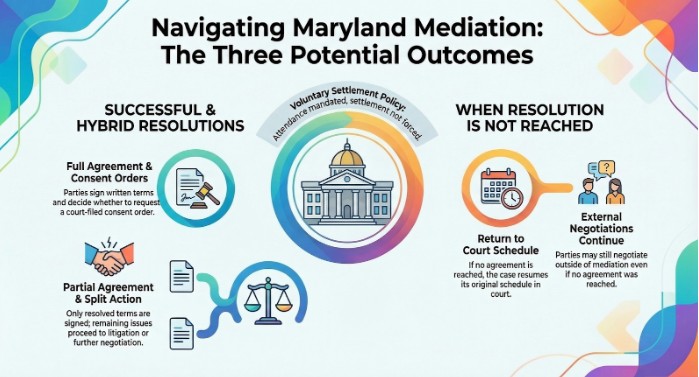
A Maryland mediation ends in one of three outcomes. full agreement, partial agreement, or no agreement.
A Maryland court can require attendance at mediation, and a Maryland court cannot force a settlement, so signatures and filed terms determine what happens next.
Parties reach full agreement and sign written terms, then parties decide whether to file and request a consent order.
Parties reach a partial agreement and sign only the resolved terms, then parties litigate or negotiate unresolved issues.
If the parties reach no agreement, the case returns to the court schedule, and the parties can continue negotiating outside mediation.
A signed agreement matters because it creates a clear record of obligations that supports later enforcement decisions. A practical enforceability baseline starts with binding agreements.
If you’re ready to get
started, call us now!
Agreement Steps. From Mediated Terms To A Signed Settlement
A mediated settlement becomes actionable when parties reduce settlement terms to a written document, confirm clarity on deadlines and deliverables, and sign final terms. A signed writing creates the baseline record that supports filing, consent orders, and enforcement options.
Use this checklist before signatures, because unclear language creates most post-mediation disputes.
Full legal names and case caption or case number, when a case exists
Effective date and deadline dates, including the time zone when deadlines are time-sensitive
Payment amount, payment dates, payment method, and late payment mechanics
Property transfer steps, including the document drafter and the fee payer
Parenting schedule defined by day, time, exchange location, and holiday rotations
Child support start date and payment channel
Decision-making authority for medical, school, and extracurricular decisions, when applicable
Communication method and response windows for co-parenting logistics
Dispute resolution clause, including a return-to-mediation step
Signature blocks and dated signature lines for each signing party
A mediator often produces a term sheet or memorandum that captures points of agreement.
Parties often convert a term sheet into a final settlement document through counsel, a designated drafter, or an agreed-upon self-draft when proceeding without attorneys.
A divorce-focused settlement often requires clarity on financial and parenting matters, so you can avoid follow-up conflict over implementation.
Filing In Maryland. What Gets Filed, Where, And Why Filing Matters
Filing matters because filing connects a signed agreement to a Maryland court case, and filing often enables a judge to enter a consent order or incorporate settlement terms into the case disposition.
Filing steps vary by court and case type, so the correct next step depends on the case posture. open case versus no open case.
Signed Agreement vs Filed Agreement vs Consent Order
Document State
What It Is
What It Does
Best Use Case
Signed agreement
Written settlement signed by parties
Creates obligations as a contract baseline
Any case type that needs clear terms
Filed agreement
Signed agreement submitted in an open case
Puts settlement terms before the court
Active cases with hearings or deadlines
Consent order
Court order entered by agreement
Creates a court-enforceable order
Family terms, support, custody schedules, deadline-driven obligations
An open Maryland case is usually the next operational step because filing creates a pathway for judicial entry and court recognition.
A family case requires forms and document standards that come from the Maryland court system, so confirm filing requirements using the Maryland Judiciary family forms directory on family forms.
A case without an open docket often leaves a settlement as a private contract until a party files a case or needs court entry for enforcement.
A Maryland scheduling order and Maryland trial calendar control deadlines, so a post-mediation plan should align filing dates with hearing dates.
An Anne Arundel County case often intersects with county-specific ADR scheduling practices, so review local procedure through ADR procedures before selecting filing targets and deadlines.
Consent Orders In Maryland. When You Need One, and What A Consent Order Does
A Maryland consent order is a court order that a judge enters based on the parties’ agreement. A consent order matters when parties need court enforcement tools, a clean case closure, or clear authority for future compliance, especially in custody, support, and time-sensitive transfer situations.
When A Consent Order Is The Right Tool
Situation
Risk Without A Consent Order
Why A Consent Order Helps
Parenting schedule and exchanges
Ambiguous pickup times create repeat disputes
A court order sets enforceable schedule terms
Child support start date and payment method
Payment confusion triggers arrears disputes
A court order standardizes the start date and channel
Alimony and asset division deadlines
Missed deadlines escalate conflict
A court order anchors deadlines and obligations
Real property or vehicle transfer steps
Transfers stall without defined steps
A court order clarifies who signs and by when
High-conflict communication boundaries
Ongoing conflict undermines performance
A court order supports compliance expectations
A consent order workflow usually follows a predictable pattern. parties finalize written terms, parties draft proposed order language, parties submit the proposed order to the court, and a judge enters the order after review for form and content.
Maryland family mediation terms often concentrate on custody, support, and property, so custody-specific preparation improves post-mediation execution.
Use custody mediation when the agreement involves time-sharing, decision-making, or parenting logistics.
Common Post-Mediation Problems And How Parties Handle Them
Post-mediation problems usually fall into four categories. unsigned drafts, unclear terms, missed performance deadlines, and disputes over interpretation.
A clean post-mediation workflow prevents these failures through clear drafting, fast signatures, and court entry when a court order is necessary.
Five Clarity Traps That Create Future Disputes
The agreement omits a start date for payments, exchanges, or access schedules.
The agreement uses subjective phrases such as “reasonable notice” without defining a time window.
The agreement references “standard holidays” without naming holidays and exchange times.
The agreement assigns obligations without naming the responsible party or specifying a deadline.
The agreement assumes future cooperation without a dispute-resolution escalation step.
A refusal to sign after mediation changes the settlement status immediately because unsigned drafts do not create final obligations.
A failure to perform after signatures creates a different enforcement question, because enforcement options depend on contract-only status versus court-order status.
Maryland family cases require safety screening when abuse concerns exist. Maryland Rule 9-205 limits mediation orders in custody and visitation disputes when a party represents in good faith that abuse exists, and mediation is inappropriate because of abuse. Review Maryland Rule 9-205 for the controlling language.
A Practical Post-Mediation Checklist For Maryland Cases
A post-mediation checklist prevents drift by assigning ownership, dates, and documents immediately after the session.
A 48-hour workflow reduces missed signatures, missed deadlines, and confusion during implementation.
Post-Mediation Timeline Checklist
Timeline
Action
Owner
Proof Of Completion
Same day
Assign the drafter of the final agreement
Parties or counsel
Draft owner confirmed in writing
Same day
Confirm signature method and signature deadline
Parties
Scheduled signing time
48 hours
Convert the term sheet into a final settlement draft
Draft owner
Draft circulated to both sides
7 days
Finalize edits and sign the settlement
Parties
Executed agreement stored
14 days
Decide filing path and prepare consent order if needed
Parties or counsel
Filing package ready
Before the next hearing
File the required documents in the correct court
Parties or counsel
Stamped receipt or docket entry
Maryland District Court ADR programs operate differently from Maryland Circuit Court ADR programs, so court type affects post-mediation expectations.
Confirm ADR program mechanics using the District Court ADR Office when the case runs through the District Court.
Confirm court type and docket posture. District Court versus Circuit Court. open case versus no open case.
Confirm the deliverable. signed agreement only, filed agreement, or proposed consent order.
Confirm the ADR office guidance when the case runs through a court program, using the District Court ADR Office as the starting point for District Court ADR.
Confirm family filing requirements using family forms when the agreement involves custody, support, or divorce.
Anne Arundel County parties can reduce guesswork on local expectations through county resources.
Contact Us Today For An Appointment
Frequently Asked Questions
What should parties do immediately after a Maryland mediation ends?
After a Maryland mediation ends, parties should confirm the outcome in writing, assign one drafter for the final agreement, set a signing deadline, and list any missing documents. Parties should also confirm the next court date and filing plan.
Does a Maryland mediation agreement need notarization to be enforceable?
A Maryland mediation agreement does not always require notarization to be enforceable. Enforceability usually depends on clear written terms and signatures. Some related documents, such as deeds or title transfers, may require notarization based on document type.
When should parties file a mediated agreement in a Maryland court case?
Parties should file a mediated agreement when a Maryland case is open and a hearing or deadline is approaching, or when parties want the judge to enter a consent order. Filing connects settlement terms to the docket for court action.
What is a consent order in Maryland, and when does a consent order matter most?
A Maryland consent order is a court order entered by agreement of the parties. A consent order matters most for custody schedules, child support, alimony, and deadline-driven obligations, because court enforcement tools apply more directly to court orders.
How long does it take for a Maryland judge to sign a consent order?
A Maryland judge’s timeline for signing a consent order varies by county, court workload, and the quality of the documents. Clean formatting, clear terms, and complete signatures speed review. Parties should plan for days to weeks rather than same-day entry.
What happens when one party refuses to sign after mediation in Maryland?
When a party refuses to sign after mediation, the parties usually have no enforceable final agreement. Parties can revise terms, schedule another mediation session, or return to the court schedule. A judge can still hear the case if the settlement fails.
What happens when one party violates a signed mediation agreement in Maryland?
A violation triggers different next steps depending on the document status. A signed agreement may be enforced as a contract. A consent order may be enforced as a court order. Parties often start with a written notice, documentation, and a compliance deadline.
Do custody and child support terms usually require a Maryland consent order?
Custody and child support terms usually work best as a Maryland consent order when a case is pending, because court orders provide clearer enforcement and administrative processing. Private agreements can exist, but court entry often prevents future disputes about terms.
Can parties change a mediated agreement after signing in Maryland?
Parties can change a mediated agreement only by mutual written modification or by returning to court, where a court order governs the terms. Child-related terms may require additional court review in an open case. A clear modification clause helps reduce conflict.
What documents should parties bring to a post-mediation drafting review?
Bring the mediator term sheet, any draft settlement language, a timeline of key events, and the documents that drive decision terms. For family cases, bring income records, expense lists, and parenting schedules. For business cases, bring contracts, invoices, and communications.