Child Support Mediation in Maryland: Can You Agree Without Going to Court?
Originally published: January 2026 | Updated: March 2026 | Reviewed by Don Saunders
When parents separate or divorce in Maryland, child support is often a significant concern. Many people believe they must go to court to resolve these financial issues.
You can reach a child support agreement in Maryland outside of court through mediation and voluntary negotiations.
Parents who can communicate and cooperate can negotiate child support in mediation without a court hearing—but you’ll typically still need a filed, court-approved order (or a Child Support Administration case) to make the terms enforceable.
This approach keeps both parents more in control of the financial outcome without requiring a court hearing.
Mediation for child support means sitting down with a neutral third party who helps you and your co-parent talk through financial responsibilities. The goal is to reach an agreement without all the court drama.
This process can help you skip those endless court battles and child support enforcement headaches later.
If you know how mediation works and what’s on the table, you’ll feel more confident deciding if it’s the right move for your family.
Key Takeaways
Parents in Maryland can agree on child support through mediation if both sides are willing to cooperate.
Mediation lets you work with a neutral third party to create a child support agreement that fits your situation.
Knowing Maryland’s child support guidelines gives you a leg up when negotiating fair agreements in mediation.
If your situation also involves disputes over parenting time or legal custody, see our custody mediation guide.
What Is Child Support Mediation in Maryland?
Child support mediation in Maryland is a voluntary process in which you and your co-parent work with a neutral third party to resolve financial support for your kids. This allows you to negotiate outside the court system while still complying with Maryland’s child support guidelines.
The Mediator’s Role
The mediator serves as a neutral guide who helps you and your co-parent discuss child support. They don’t make decisions for you or take sides.
Your mediator helps keep the conversation focused on your child’s needs and makes sure you both communicate clearly.
They can explain how Maryland child support guidelines work and what the court looks at when setting support amounts.
The mediator will not provide legal advice. Their job is to create a safe space so both of you can negotiate terms that make sense for your family.
If you reach an agreement, the mediator helps you write it up so you can submit it to the court for approval.
Common support issues covered in mediation include:
Health insurance coverage and medical expenses
Educational costs and school-related fees
Childcare and daycare expenses
Extracurricular activity costs
Special/private elementary or secondary school expenses (when applicable) and transportation between parents’ homes (if agreed or ordered)
Life insurance requirements
You can also discuss how to handle changes in circumstances going forward. Mediation gives you some flexibility to tailor things to your family, as long as you stay within Maryland’s legal requirements.
The agreement must still meet the state’s child support standards to obtain court approval.
Saunders Mediation offers a free consultation (available 24/7) to help Maryland parents build a court-ready child support agreement through mediation. Schedule a consultation.
If you’re ready to get
started, call us now!
Can You Agree On Child Support Without Going To Court In Maryland?
Parents in Maryland can reach private agreements on child support amounts, but there are some big legal limits. On June 27, 2025, the Supreme Court of Maryland held that parents may not waive child support—even by mutual agreement—because the right to support belongs to the child, not the parents.
Private Agreement Vs. Court-Approved Consent Order
You and your co-parent can work out child support terms privately at first, without the court. These informal arrangements allow you to be flexible with payment amounts, schedules, and methods.
But private agreements come with real risks. They’re not legally enforceable, so if your co-parent stops paying, you can’t use the court to collect.
A court-approved consent order turns your agreement into an official child support order. You submit your terms to a judge, and the court checks if your deal meets Maryland’s guidelines and looks out for your child’s best interests.
Once a judge signs off, the order is legally binding—no more handshake deals.
Key differences include:
Private Agreement
Court-Approved Consent Order
No legal enforcement
Full enforcement power
Can be changed verbally
Requires formal modification
No official payment record
Court-tracked payments
Doesn’t automatically create court-enforceable arrears if unpaid
Creates legal debt if unpaid
In uncontested divorce cases, your child support agreement can roll right into your marital separation agreement.
When “We Agree” Still Needs Court Involvement
Even if you and your co-parent agree on everything, a mediated agreement can be valid as a contract, but you’ll typically need court approval to make it enforceable as a child support order (including court-enforcement tools).
You can negotiate outside of court, but you’ll typically need court approval to make your agreement enforceable as an order.
Agreements must undergo judicial scrutiny before they become official child support orders. The judge considers whether your agreed amount truly supports your child and complies with state guidelines.
The court might reject deals that stray too far from Maryland’s child support calculations unless you have a really good reason. Judges will always prioritize the child’s financial needs.
You’ll need to file formal paperwork with the circuit court, like a Complaint for Child Support and financial statements. This step turns your agreement into an enforceable order—so if someone stops paying, there are consequences.
How Maryland Calculates Child Support (The Pieces You Need Before You Negotiate)
Maryland uses specific income ranges and different worksheets depending on your custody arrangement. Knowing which calculation method applies to you helps you negotiate realistic payments before mediation even starts.
Guidelines And The Income Range Where The Schedule Applies
Maryland uses the income-sharing model to calculate child support. It states that children should receive the same share of parental income they’d have if both parents were still together.
The state has a schedule showing basic support amounts based on combined parental income. The Maryland Child Support Guidelines apply when your combined monthly income falls within the schedule’s range.
If your income exceeds the upper limit, the court uses alternative methods. If it’s below the lower limit, the judge may adjust it based on each parent’s ability to pay.
Both parents have to report gross earnings from all sources. The court considers work-related child care, health insurance costs, and any major medical expenses when calculating the final amount.
These extras can significantly affect what you’ll negotiate in mediation.
Worksheet A Vs Worksheet B
Maryland offers two worksheets depending on custody. Worksheet A is for when one parent has sole physical custody. Worksheet B is for shared physical custody—meaning each parent has the child at least 25% of the overnights (about 92+ nights a year).
The worksheet you pick makes a big difference. Worksheet B reflects that both parents spend significant time with the child, so support payments are typically lower than in Worksheet A.
It’s important to know your overnight count before you start mediation. If paternity hasn’t been established, Maryland law says you have to do that before the court will calculate support or set up wage garnishment.
What You Can And Can’t “Trade” In Child Support Mediation
You can’t permanently waive or trade away child support, but you can negotiate other financial stuff during mediation. The law protects your child’s right to support, no matter what you and your co-parent agree to privately.
Non-Negotiables
Child support isn’t something you can just eliminate in mediation. Courts have to approve any agreement, and they’ll reject deals that don’t meet your child’s needs.
You can’t swap your child’s right to support for custody or visitation rights. Those agreements don’t hold up because either parent can return to court and seek guideline support later.
A parent who agrees to trade custody rights for no child support can always change their mind. The court sees child support as the child’s right, not something parents can bargain away.
Even property division agreements intended to replace future child support may not hold up if circumstances change.
Negotiables
You can negotiate financial matters that affect your overall settlement. Spousal support or alimony is separate from child support, and you can work that out in mediation.
Property division is pretty flexible in mediation. You could agree on how to split:
Real estate equity
Retirement accounts
Vehicles and personal property
Debt responsibility
Life insurance policies can be part of your deal, too. You should require one parent to keep coverage naming the kids as beneficiaries, to secure future support.
You can also negotiate payment schedules, methods, and who is responsible for claiming tax deductions. Just keep in mind that any child support amount must meet state guidelines, or the court won’t approve it.
Bring your income and childcare numbers, and let a neutral mediator keep the discussion productive—Saunders Mediation helps parents reach workable support terms faster. Contact us
If you’re ready to get
started, call us now!
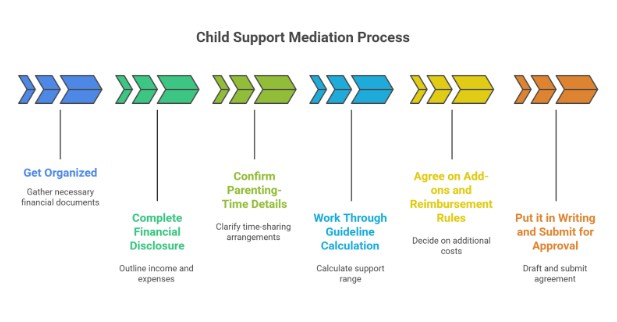
Step-By-Step: A Practical Child Support Mediation Process (What To Expect)
The mediation process really has two main parts. First, gather your documents and sort out financial information in advance.
Then, you work with the mediator to create an agreement that the court can approve and enforce.
Get organized before the first session.
Gather pay stubs, the last two years of tax returns, proof of any extra income, and records of child-related costs (childcare, health insurance, medical expenses).
Complete financial disclosure.
Each parent outlines income and monthly expenses, ensuring the discussion is based on real numbers rather than estimates.
Confirm parenting-time details.
Clarify overnights/time-sharing (and any schedule realities) because it affects which worksheet and the guideline result.
Work through the guideline calculation.
Use disclosed income and core inputs to identify a guideline-based support range, then discuss how it fits your situation.
Agree on add-ons and reimbursement rules.
Decide who covers health insurance, how uncovered medical costs are split, and how childcare/activities/school costs are handled—with clear proof and deadlines.
Put it in writing and submit for approval.
Draft specific terms (exact amounts, due dates, payment method) and submit them so the agreement can be approved and enforced as an order.
Mediation Vs Court For Child Support Disputes In Maryland
Mediation gives parents a way to settle child support amounts together, without a judge calling the shots. The court steps in when parents can’t agree or when safety concerns make negotiation impossible.
When Mediation Is A Strong Fit
Mediation works best when both parents communicate respectfully and seek common ground. If you’re both willing to negotiate in good faith, a mediator can help you resolve disagreements over income, expenses, and support.
Child support mediation in Maryland makes economic sense. The state’s guidelines are straightforward, so most disputes center on clarifying finances rather than arguing over complex legal details.
You can resolve your case faster through mediation than by waiting for court dates. Mediation costs less than litigation, since you avoid multiple hearings and high attorney fees.
Mediation is ideal when:
Both parents are willing to share financial documents honestly
You want to maintain a cooperative relationship for your child’s sake
Neither parent has concerns about abuse or safety
You both understand the child support guidelines, but need help applying them to your situation
When Court Is The Safer Or Better Option
Court becomes necessary when mediation can’t work safely or effectively. Maryland courts may not order mediation if someone raises a genuine issue of abuse—no one should have to negotiate in an unsafe environment.
Go to court if the other parent refuses to participate in mediation or won’t provide accurate financial information. Some parents hide income, underreport earnings, or simply refuse to cooperate.
Court is the better choice when:
One parent has a history of domestic violence or abuse
The other parent won’t share financial records or tax documents
One party refuses to negotiate or attend mediation sessions
You need the court’s authority to enforce income withholding orders immediately
Court proceedings provide you with formal tools to compel the other parent to disclose financial information. A judge can issue binding orders with real legal consequences if someone doesn’t comply.
Common Sticking Points (And How Parents Resolve Them Without A Judge)
Parents often disagree about how custody schedules affect support calculations or who pays for expenses such as daycare and braces.
These issues become easier to solve when both people focus on the child’s actual needs rather than trying to “win.”
Overnights And Schedule Realities
Your parenting time schedule directly affects child support calculations in Maryland. The state uses a formula that considers each parent’s number of overnights each year.
Parents sometimes argue about whether a schedule is truly 50/50 or more like 60/40. For example, does dropping off a child at 7 AM count as an overnight? People see it differently.
Mediation helps resolve family disputes by allowing you to talk through the details. You can review your work schedules and your child’s activities to create a realistic parenting plan.
Many parents track a typical month and agree on what counts as an overnight. If one parent travels for work or works nights, you can adjust the agreement accordingly.
The mediator helps you focus on what actually happens, not just what sounds fair on paper. It’s not always simple, but a little flexibility goes a long way.
Childcare, Insurance, And Out-of-Pocket Medical
Medical expenses and childcare costs often lead to disputes because they must be paid quickly. Your co-parenting arrangement should set clear rules about who pays for what and when.
Health insurance premiums are included in the support calculation, but parents often disagree on out-of-pocket costs. Do you split a $40 co-pay? What about orthodontia or therapy?
Through cooperative mediation, you can set specific guidelines. Many parents agree to split unreimbursed medical expenses above a certain threshold, such as $250 per year.
In Maryland, the guideline schedule applies when parents’ combined gross monthly income is $30,000 or less; above that, courts treat it as an ‘above-guidelines’ case and use additional discretion.
Others divide all costs based on each parent’s income. Childcare brings similar challenges. You might need different arrangements during the summer versus the school year.
College expenses also come up if you want to address them now. There’s no single right answer—just what works for your family.
Common solutions parents choose:
Split all medical bills above a set dollar amount
One parent covers insurance, the other handles copays
Divide daycare costs based on who uses it
Create a shared account for predictable expenses
Where To Find Mediation Programs And Resources In Maryland
Maryland offers mediation services through both court-run programs in each county and independent private practitioners specializing in family law disputes.
Court-Connected Mediation Vs Private Mediation
You have two main ways to access mediation in Maryland. Court-connected programs run through community mediation centers in each county and might be available before or after you file a court case.
The court can also refer you to mediation once you file. Many of these programs now offer remote services, making participation easier.
Court-connected mediation usually costs less than private services and is free, depending on your income. Private mediators work independently outside the court system.
You can search for private practice mediators using the Maryland Program for Mediator Excellence directory. This online tool lets you filter by county, dispute type, and mediator name.
Private mediators often offer more flexible scheduling and greater expertise in child support cases. You pay their fees directly, which are usually higher than those of court programs, but they can move your case along faster.
County-Level Starting Points
Your county has its own mediation center that deals with family law cases. If you want to start finding mediation services, you’ll need to look up the program in your specific county through the Maryland Courts website.
Each county program offers help with child support disputes. This applies to divorce, paternity, or custody issues.
The Maryland Child Support Administration works directly with parents to set up financial support arrangements. Sometimes the process can feel overwhelming, but they can walk you through it.
Can parents agree on child support through mediation in Maryland?
Yes. Mediation allows parents to negotiate payment amounts and expense sharing without a court hearing. For the terms to be enforceable, like any support order, you typically submit the written agreement for judicial approval as a consent order.
Is child support mediation confidential in Maryland?
Generally, yes—Maryland courts treat mediation as confidential, so discussions usually can’t be used later in court. Key exceptions include child abuse, imminent threats of harm, and allegations of duress or fraud.
Can we waive child support if we both agree?
No. On June 27, 2025, the Supreme Court of Maryland held parents may not waive child support (or arrears) by agreement, because the right to support belongs to the child, not the parents.
How does Maryland calculate child support for mediation negotiations?
Maryland uses an income-sharing guideline formula based on both parents’ gross incomes, the number of children, and the custody arrangement. If the combined monthly income is $30,000 or less, the guideline schedule applies; childcare, health insurance, and certain medical costs are added in.
When do you use Worksheet A vs. Worksheet B in Maryland?
Use Worksheet A when one parent has primary physical custody (the other has under 25% of overnights). Use Worksheet B for shared physical custody—each parent has more than 25% of overnights (about 92+ nights) in a year.
What documents should we bring to child support mediation?
Bring recent pay stubs, the last two years of tax returns, and proof of other income. Also, gather childcare invoices, the child’s health insurance premium information, unreimbursed medical receipts, and a clear parenting schedule/overnight count for the worksheet.
How do we make a mediated child support agreement enforceable?
Put every term in writing—monthly amount, due date, payment method, and how you split insurance, childcare, and medical add-ons. File it with the circuit court so a judge can review it and enter a consent order.