Maryland Parenting Plans: Complete Guide to CC-DR-109 and CC-DR-110 Forms
Originally published: September 2025 | Reviewed by Don Saunders
Maryland parents facing divorce or separation now have to deal with new rules for parenting plans under Maryland Rule 9-204.1.
Each parent fills out a parenting plan using form CC-DR-109. This written agreement outlines how they’ll care for and make decisions about their children.
If parents can’t agree on everything, they have to use a different form.
Knowing when to use CC-DR-109 or CC-DR-110 can save you from headaches and delays in court.
It really comes down to whether you can work things out together or need a judge to intervene in the challenging situations.
Key Takeaways
Maryland requires all divorcing parents to fill out parenting plan forms under Rule 9-204.1.
Form CC-DR-109 fits when parents can agree on most or all parenting decisions.
Form CC-DR-110 is used when parents cannot agree on key issues.
What Is A Parenting Plan In Maryland?
A parenting plan in Maryland is a legal document that outlines how parents will make decisions and share responsibilities for their children after a breakup or divorce.
Maryland courts aim to implement these plans to minimize conflict and prioritize the children’s needs during custody battles.
A parenting plan is a written agreement between parents regarding the best interests of their children.
Whenever a custody case involves a minor, Maryland courts expect a parenting plan.
The plan covers both physical custody (where the children live) and legal custody (who makes decisions on significant matters such as education, health, and religion).
Parents use the Maryland Parenting Plan Tool (CC-DR-109) for this. That form guides parents through the important details: schedules, holidays, transportation, and how to stay in touch.
This plan allows parents to decide what works best for their family, rather than leaving it up to a judge.
It gives families more say in how co-parenting will look moving forward.
Minimizing Conflict And Supporting Children’s Stability
Maryland’s parenting plans aim to reduce conflicts and provide children with some stability.
The plan lays out clear rules and expectations for both parents.
It addresses common trouble spots upfront. There are steps for handling disagreements and making changes later on.
That way, you can avoid confusion and arguments before they even start.
Kids benefit from knowing what to expect. They see when they’ll be with each parent and how hand-offs will work.
That predictability can help lower their stress during a tough time.
The plan also outlines how parents will communicate about matters such as school events or doctor visits.
It might specify how and when parents should update each other about what’s going on with the kids.
Mediation Before Trial
Maryland courts want parents to try mediation before heading to trial.
The parenting plan forms are designed to encourage parents to discuss significant decisions for their children.
Parents can complete the plan on their own, together, or with the help of a mediator.
Mediation provides both sides with an opportunity to discuss their concerns in a neutral setting and potentially find mutually beneficial solutions.
When parents go through mediation, they keep more control over what happens.
They can work out arrangements that actually fit their family’s quirks and needs.
If mediation doesn’t work, the case goes to trial, and a judge calls the shots on custody.
However, most families resolve disputes through mediation, which is typically less stressful and less expensive for everyone.
Simplify your custody process with Saunders Mediation’s family mediation services in Maryland. Create a clear, child-focused parenting plan and avoid costly disputes—contact us today to schedule a session.
This form explores who has the authority to make decisions, how parenting time is divided, and how everyone will maintain communication.
At the first court appearance, parents get CC-DR-109 and instructions. Both parents fill out their parts, and after the court signs off, the plan becomes official.
Maryland Rule 9-204.1 says you have to complete this form in custody cases.
You can go as general or as detailed as you want, depending on your family’s situation.
The final plan must encompass all the major aspects: medical decisions, educational choices, and where the kids will reside.
Sections Of The Form
CC-DR-109 has several sections, each covering a different part of parenting:
The child’s needs and, if old enough, their preferences
What’ll keep things stable for the family
Courts often prefer parents to resolve issues on their own, but sometimes that’s simply not realistic.
When CC-DR-109 doesn’t cut it, court intervention steps in.
Practical Examples
One common CC-DR-110 scenario is when parents can’t agree on visitation times, even if they’re fine with decision-making.
Medical disagreements pop up a lot too—maybe one parent wants alternative medicine and the other sticks with traditional care.
Other disagreements that call for CC-DR-110:
Arguing over public vs. private school
Vacation schedule conflicts
Fights about extracurriculars
Clashing rules on technology
Religious differences can also lead to CC-DR-110. Parents from different faiths may not share the same views on religious education.
The form allows parents to indicate where they agree and where they disagree, so the court knows what it needs to decide.
Confused about Forms CC-DR-109 or CC-DR-110? Saunders Mediation can guide you through every step to protect your child’s best interests. Take action now—schedule your mediation with us.
Key Differences Between CC-DR-109 And CC-DR-110
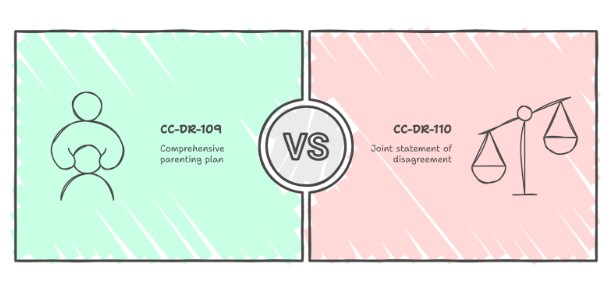
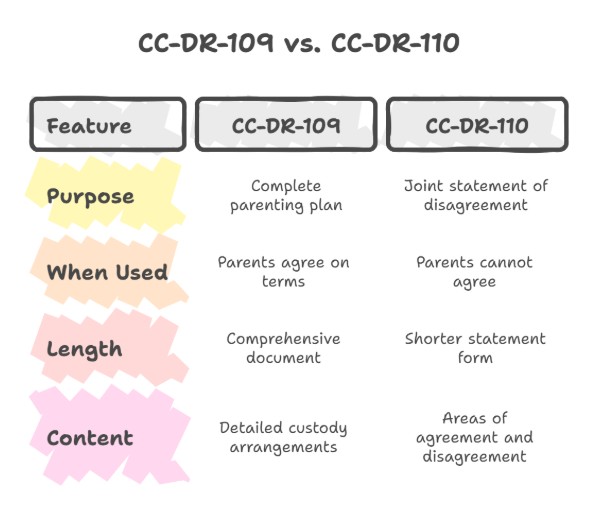
Form CC-DR-109 is the go-to document for parents who agree on how to handle custody.
Form CC-DR-110 is a joint statement for situations when parents cannot agree on everything in their plan.
Form CC-DR-109 requires parents to outline specific parenting decisions, visitation schedules, and holiday plans. Parents use this form when they can actually sit down and work out a full custody plan together.
Form CC-DR-110 comes into play when parents just can’t agree, no matter how hard they try. This joint statement outlines the areas of agreement and disagreement on custody issues.
Even with CC-DR-110, both parents still have to collaborate. They fill out the joint statement together, despite disagreeing on major parenting decisions.
Court Preference For CC-DR-109
Maryland courts tend to favor form CC-DR-109 over CC-DR-110. Judges appreciate a comprehensive parenting plan because it demonstrates that parents can cooperate and make choices that benefit their children.
When parents complete CC-DR-109, judges view it as a sign that they’ll handle future custody changes without requiring everyone to return to court. This approach usually resolves cases more efficiently as well.
Courts require CC-DR-110 only when parents can’t reach an agreement, even after good faith efforts. The joint statement makes parents pinpoint exactly where they need a judge’s help.
Parents who file CC-DR-110 often face longer court processes. The judge must decide on the tough issues, rather than just approving a plan that both parents already like.
How Mediation Supports Maryland Parenting Plans
Mediation offers a collaborative way for parents to create CC-DR-109 forms and settle custody issues outside of court.
It helps families create comprehensive parenting plans, maintains peace, and can save a significant amount of money on legal fees.
Role Of Mediation In CC-DR-109 Disputes
Mediation steps in as an alternative when parents can’t agree on parenting plan details. A neutral mediator works with both parties to resolve disagreements over custody schedules, decision-making, and other complex issues.
Mediators don’t make decisions for parents—they simply guide the conversation and help parents find common ground. Honestly, this often works out better than letting a judge call all the shots.
Parents who undergo mediation typically come away with more detailed and practical parenting plans. They have the opportunity to address unique family needs that standard court forms may overlook.
Common mediation topics include:
Weekly custody schedules
Holiday and vacation arrangements
Transportation responsibilities
Communication methods between parents
Decision-making for medical and educational needs
When parents reach a mediation agreement, they can fill out the CC-DR-109 form together. This makes the dreaded Joint Statement forms (CC-DR-110) less likely.
Saunders Mediation’s Guidance
Professional mediators help parents navigate the complex maze of parenting plans. They are familiar with Maryland’s rules and can guide families through each section of the CC-DR-109 form.
Experienced mediators identify potential trouble spots before they escalate into bigger problems. They push parents to consider scenarios they might not think of on their own, which helps avoid future headaches and court trips.
Mediation guidance covers:
Age-appropriate custody arrangements
Flexibility for changing family needs
Clear communication protocols
Conflict resolution strategies
Mediators also explain legal options and how different choices may affect the family in the future. That way, parents can make decisions with a little more confidence about their kids’ future.
Benefits Of Mediation
Mediation just has a lot going for it compared to a court fight. Parents maintain control over the decisions, rather than handing everything over to a judge.
Key benefits include:
Lower costs than litigation
Faster resolution times
Private discussions outside public courtrooms
Customized solutions for unique family situations
Better co-parenting relationships after divorce
Children tend to do better when their parents use mediation for their parenting plans. The process cuts down on conflict and stress, which can be rough on children during custody battles.
Parents who mediate usually report more satisfaction with their final parenting plans. They’re more likely to follow the arrangements, probably because they actually helped create them. That kind of stability helps everyone.
Mediation also helps parents keep a working relationship. They pick up communication skills that make co-parenting easier, long after the divorce is final.
Checklist For Completing Maryland Parenting Plan Forms
Parents need to gather details about schedules, holidays, communication styles, and how they’ll handle disputes before they fill out parenting plan forms.
Parents should create detailed weekly and monthly schedules before completing the forms. The schedule needs to lay out which days and times each parent spends with the kids.
Weekday Schedule Requirements:
School pickup and drop-off times
Overnight stays during school weeks
After-school activity transportation
Homework supervision arrangements
Weekend Schedule Details:
Friday evening pickup times
Sunday evening return times
Alternating weekend patterns
Special weekend events or activities
Parents should factor in work schedules when planning parenting time. Shift workers require flexible plans that can accommodate changing work hours. The Maryland Parenting Plan Tool covers both regular and alternative schedules.
Summer schedules typically differ from school-year routines. Parents need to decide how to divide up long vacations and extended visits.
Identify Holidays And Travel Plans
Holiday schedules take some extra planning to avoid headaches. Parents need to agree on which holidays each parent gets with the kids.
Major Holidays to Address:
Thanksgiving and Christmas breaks
New Year’s Day and Easter
Memorial Day and Labor Day weekends
Children’s birthdays and parent birthdays
Holiday Rotation Options:
Alternating years for each holiday
Splitting longer breaks in half
Odd/even year assignments
Fixed holiday assignments
Travel plans usually require advance notice. Most plans ask for 30-60 days notice for trips longer than a few days. Parents should clearly outline what information they’ll share about travel destinations and how to reach them.
International travel often requires the written consent of both parents. The plan should cover passport custody and how they’ll handle travel approvals.
Choose Communication Methods
Parents must decide how they’ll keep each other informed about their children’s needs and schedules. Setting clear rules for communication helps avoid confusion and fights.
Communication Options:
Phone calls for urgent matters
Text messages for quick updates
Email for detailed information
Parenting apps for scheduling changes
Response time rules make sure nobody gets left hanging. Many plans require replies within 24-48 hours for non-emergencies.
Emergencies need their own rules. Parents should agree on what counts as an emergency and the fastest way to reach each other. Medical issues and school problems typically require immediate attention.
Kids’ communication with the non-custodial parent also needs a plan. Parents should agree on how often kids call or video chat.
Consider Dispute Resolution Methods
Parents need a strategy for handling disagreements about the kids. The parenting plan should lay out steps to try before heading to court.
Mediation often works out well for parenting disputes. A mediator helps parents brainstorm solutions that actually fit their family. Many plans require mediation to be a prerequisite before anyone files court papers.
Some parents opt for collaborative law, utilizing specially trained lawyers to avoid court proceedings.
The plan should say who pays for mediation or other services. Most parents split these costs evenly.
Center The Child’s Best Interests
Every parenting plan decision should focus on what’s best for the kids. Maryland courts require parents to consider specific factors when establishing custody arrangements.
Key Best Interest Factors:
Children’s physical and emotional needs
Each parent’s ability to provide stable care
Existing relationships with extended family
School and community connections
The kids’ ages make a significant difference. Younger children typically require more frequent contact with both parents, whereas teens often want to have a say in their own schedules.
Children with special needs require extra planning—considering medical appointments, therapy, and educational support, all of which must be integrated into the parenting schedule.
Parenting plans should allow for adjustments as children grow. What works for a five-year-old won’t always work for a fifteen-year-old. Adding review periods makes it easier to adjust the plan over time.
Conclusion
Maryland parenting plans provide parents with a means to establish clear agreements regarding the care and upbringing of their children. The CC-DR-109 form serves as the primary tool for compiling these plans.
If parents can’t agree on everything, they use the CC-DR-110 Joint Statement form. This form allows each parent to tell the court what they believe is in the best interest of their child.
Maryland courts hand out these forms during the first court appearance. Parents get instructions and a planning tool to help them work through the process, step by step.
Your parenting plan is too important to leave to chance. Saunders Mediation helps Maryland families reach lasting custody agreements with less stress. Secure your child’s future—contact us today to schedule.
Frequently Asked Questions
What is a parenting plan in Maryland?
A Maryland parenting plan is a written agreement that outlines how separated parents will share custody, make decisions, and handle scheduling. Courts encourage parents to use this plan to reduce conflict, provide stability for children, and support co-parenting after separation or divorce.
What is Maryland Form CC-DR-109 used for?
Form CC-DR-109 is the official Parenting Plan Tool. Parents use it to propose a joint custody schedule, define decision-making authority, and set rules for communication and dispute resolution. Submitting this form demonstrates cooperation and helps courts approve a workable child-focused plan.
When should parents file Form CC-DR-110 instead?
Form CC-DR-110, the Parenting Plan Joint Statement, is used when parents cannot agree on all details in CC-DR-109. Each parent submits their position on disputed issues, and the court makes custody and visitation decisions based on the child’s best interests.
What’s the difference between CC-DR-109 and CC-DR-110?
CC-DR-109 is a collaborative parenting plan that parents file when they agree on custody terms. CC-DR-110 is filed when disagreements remain, allowing the court to review unresolved issues. Maryland courts prefer CC-DR-109 because it promotes cooperation and reduces courtroom conflict.
Do Maryland courts require parenting plans?
Yes. Maryland law requires parents in custody or visitation cases to submit a parenting plan. If parents agree, they file CC-DR-109. If they disagree, each parent must complete CC-DR-110 so the court can decide contested matters.
Can mediation help with Maryland parenting plans?
Yes. Mediation helps parents complete CC-DR-109 by resolving disagreements over custody schedules, decision-making, or holidays. A mediator provides neutral guidance, making it easier to finalize a child-focused plan and avoid the court having to impose CC-DR-110 outcomes.