What Happens If Mediation Fails in Maryland? Next Steps After an Impasse
Originally published: June 2026 | Reviewed by Don Saunders
Mediation failure in Maryland means the mediator declares an impasse, and parties leave without a fully signed agreement. Maryland courts cannot compel parties to settle during family mediation, so an impasse returns the case to litigation or opens alternative resolution paths.
Parties retain all pre-mediation legal rights after an impasse, including the right to file or continue a lawsuit, pursue arbitration, or attempt a second mediation session.
Key Takeaways
A mediation impasse in Maryland preserves all pre-mediation legal rights, including the right to file or continue a lawsuit in Circuit Court or District Court.
Partial agreements on resolved issues reduce the scope and cost of any subsequent litigation by narrowing what a judge must decide.
Maryland Rule 17-105 protects mediation communications from disclosure in court, so discussions during a failed session generally remain confidential.
Statutes of limitations continue to run during mediation in Maryland unless the parties sign a written tolling agreement before or during the process.
Uncertainty after mediation stalls progress on custody, support, and property terms. Saunders Mediation helps Annapolis families evaluate next steps after impasse.
If you’re ready to get
started, call us now!
What Does Mediation Impasse Mean in Maryland
A mediation impasse occurs when parties and the mediator conclude that further negotiation will not produce a full agreement during the current session. The mediator formally ends the process, reports the impasse to the referring court without disclosing reasons, and the case returns to the active docket for further proceedings.
Maryland courts define mediation as a voluntary process governed by the principle of self-determination.
The Maryland Judiciary ADR Office confirms that courts may order parties to attend mediation, but cannot order them to reach an agreement.
Maryland Rule 17-105 establishes that mediation communications remain confidential, so a mediator cannot testify about what either party said, offered, or rejected during sessions.
When a Mediator Declares Impasse
A mediator declares impasse when positions remain fixed after good-faith attempts at compromise. The declaration triggers no penalties in Maryland courts. Judges do not sanction parties for failing to agree, and the impasse does not create a negative inference in subsequent proceedings.
How Impasse Differs From a Communication Breakdown
An impasse reflects substantive disagreement after productive discussion. A communication breakdown involves refusal to participate, emotional escalation, or safety concerns that prevent structured negotiation.
Maryland Rule 9-205 prohibits court-ordered mediation in custody and visitation disputes when a party represents in good faith that abuse exists and mediation would be inappropriate. The full text of Rule 9-205 controls the abuse exception standard.
Can You Still Go to Court After Mediation Fails in Maryland
Parties retain the full right to pursue litigation in Maryland after mediation fails because mediation is non-binding unless both parties sign a settlement agreement.
A failed session does not waive any claims, defenses, or procedural rights, and the case either continues on its existing court track or parties initiate new litigation.
Court-Ordered Mediation and Return to the Docket
Maryland courts routinely order mediation before trial in family, civil, and business cases. When court-ordered mediation ends without agreement, the court restores the case to the trial calendar.
Anne Arundel County Circuit Court and other Maryland circuits use scheduling orders that build mediation deadlines into the pretrial timeline, so the next hearing date often follows within weeks of a declared impasse. Parties can review county-specific ADR practices before scheduling the next hearing date.
Voluntary Mediation and Filing a New Case
Parties who attempted voluntary mediation without an open case retain the right to file a complaint in the appropriate Maryland court.
Filing requires identifying the correct venue, calculating applicable deadlines, and preparing a complaint that avoids referencing protected mediation communications.
Maryland mediation confidentiality rules bar both parties from introducing statements, offers, or admissions from sessions as evidence.
How Partial Agreements Work When Full Resolution Fails
A partial agreement resolves some disputed issues while leaving others for further negotiation, arbitration, or litigation in Maryland courts. Partial agreements narrow the contested issues a judge must decide and reduce the cost and duration of any subsequent court proceeding by removing settled matters from the trial calendar.
A written partial agreement functions as a contract on the resolved issues. The parties sign the partial terms, and the mediator separately produces a memorandum identifying unresolved issues.
Maryland courts accept partial agreements for filing and may enter consent orders on resolved issues while scheduling remaining disputes for trial or further ADR.
What a Partial Agreement Memorandum Should Include
A partial agreement memorandum identifies resolved issues with specific terms, lists unresolved issues requiring further action, includes signatures and a date from both parties, and contains a clause preserving each party’s rights regarding unresolved matters.
A divorce mediation partial agreement might resolve property division while leaving alimony for litigation.
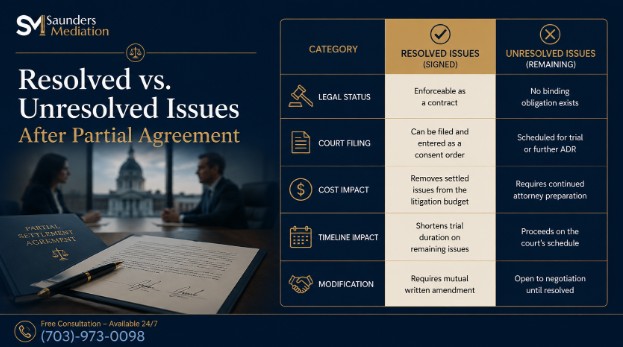
Resolved vs. Unresolved Issues After Partial Agreement
Category
Resolved Issues (Signed)
Unresolved Issues (Remaining)
Legal status
Enforceable as a contract
No binding obligation exists
Court filing
Can be filed and entered as a consent order
Scheduled for trial or further ADR
Cost impact
Removes settled issues from the litigation budget
Requires continued attorney preparation
Timeline impact
Shortens trial duration on remaining issues
Proceeds on the court’s schedule
Modification
Requires mutual written amendment
Open to negotiation until resolved
Filing a Partial Agreement in an Open Maryland Case
Filing a partial agreement follows the same process as filing a full agreement. Parties submit the signed document to the court, request entry on the docket, and may ask the judge to enter a consent order on the resolved terms. The court then schedules the remaining issues, including alimony, for a hearing or trial.
Unresolved mediation issues drain time and escalate legal costs. Saunders Mediation structures partial agreements and transition plans for disputes in Maryland.
If you’re ready to get
started, call us now!
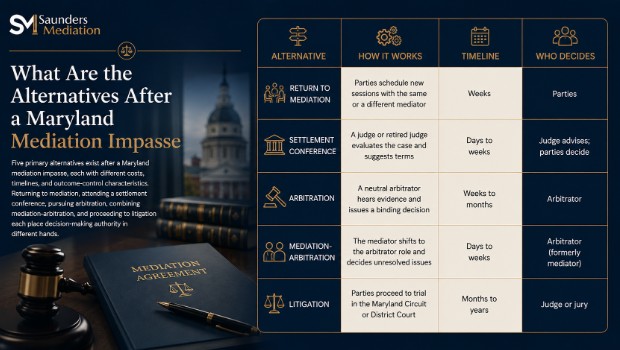
What Are the Alternatives After a Maryland Mediation Impasse
Five primary alternatives exist after a Maryland mediation impasse, each with different costs, timelines, and outcome-control characteristics. Returning to mediation, attending a settlement conference, pursuing arbitration, combining mediation-arbitration, and proceeding to litigation each place decision-making authority in different hands.
Alternative
How It Works
Timeline
Who Decides
Return to mediation
Parties schedule new sessions with the same or a different mediator
Weeks
Parties
Settlement conference
A judge or retired judge evaluates the case and suggests terms
Days to weeks
Judge advises; parties decide
Arbitration
A neutral arbitrator hears evidence and issues a binding decision
Weeks to months
Arbitrator
Mediation-arbitration
The mediator shifts to the arbitrator role and decides unresolved issues
Days to weeks
Arbitrator (formerly mediator)
Litigation
Parties proceed to trial in the Maryland Circuit or District Court
Months to years
Judge or jury
Returning to Mediation With a Different Approach
A second mediation attempt succeeds more often when parties change one variable — a different mediator, a narrower issue list, or the addition of legal counsel.
The Maryland Program for Mediator Excellence maintains a qualified mediator directory that helps parties identify mediators by subject-matter fit and court qualification.
Parties can also compare resolution methods before selecting a second attempt or switching paths.
Settlement Conferences and Mediation-Arbitration
Maryland Circuit Courts offer pretrial settlement conferences where a judge or experienced attorney evaluates the case and provides non-binding recommendations.
Settlement conferences differ from mediation in that the neutral party offers opinions on likely court outcomes, helping parties recalibrate expectations after an impasse.
The Maryland Appellate Court ADR Division provides settlement and mediation services at the appellate level.
Mediation-arbitration combines both processes in sequence. The neutral first mediates, then shifts to the arbitrator role and issues a binding ruling on unresolved issues. Mediation-arbitration guarantees a resolution without requiring parties to start a separate proceeding.
Litigation as the Final Resolution Path
Litigation remains the default path when all voluntary methods fail. Maryland family litigation involves discovery, depositions, and trial testimony.
Business mediation disputes that reach an impasse transition to civil litigation with motion practice, expert disclosures, and pretrial conferences. Litigation costs typically exceed mediation costs because discovery, depositions, and trial preparation add layers of expense that mediation avoids.
The Maryland People’s Law Library notes that court cases routinely drag on for months or years compared to mediation timelines measured in weeks.
How Statutes of Limitations Affect Options After Failed Mediation
Statutes of limitations in Maryland continue to run during mediation unless the parties execute a written tolling agreement. Missing a filing deadline forfeits the right to sue, regardless of the strength of the underlying claim, so post-impasse deadline management requires immediate attention.
Maryland Courts and Judicial Proceedings Code § 5-101 applies a three-year statute of limitations to most civil actions, including contract claims and personal injury claims.
Property damage and fraud claims carry distinct deadlines that depend on the facts. Parties engaged in civil mediation should confirm applicable deadlines before the first session begins.
Tolling Agreements and Protective Filing
A tolling agreement pauses the statute of limitations for a defined period while the parties attempt to resolve the matter. Parties who mediate near a filing deadline should either execute a tolling agreement before mediation begins or file a protective complaint to preserve claims while continuing settlement discussions.
When to File a Protective Complaint
Scenario
Risk Without Action
Recommended Step
Filing deadline within 60 days of impasse
Claim expires permanently
File a protective complaint immediately
Filing deadline 6+ months away
Low immediate risk
Monitor the deadline and consider a tolling agreement
Tolling agreement already signed
Deadline paused
Continue negotiation within the tolling period
No open case and no tolling agreement
Full exposure to expiration
Consult counsel on filing timeline
A protective complaint preserves both litigation and continued ADR rights simultaneously. Filing does not prevent continued negotiation, additional mediation, or voluntary settlement. Parties can dismiss the complaint if mediation succeeds after filing.
Every week without a resolution strategy increases litigation exposure and emotional cost. Saunders Mediation moves Annapolis families from impasse to action.
Contact Us Today For An Appointment
Frequently Asked Questions
What does mediation impasse mean in Maryland family cases?
A mediation impasse in Maryland family cases means neither party reached an agreement after good-faith negotiation. The mediator ends the session, notifies the court without revealing discussion details, and the case returns to the active family court docket for scheduling.
Does a failed mediation session hurt your case in Maryland court?
A failed mediation session does not hurt your case in Maryland court. Maryland Rule 17-105 protects mediation communications from disclosure, so judges receive no information about offers, positions, or reasons for impasse. The failed session does not create a negative inference during subsequent trial proceedings.
Can Maryland courts force you to settle during mediation?
Maryland courts cannot force a settlement during mediation under any circumstances. Courts order attendance and good-faith participation under Maryland’s ADR rules, but the voluntary nature of mediation means parties alone decide whether to sign an agreement or leave the session without one.
How does a partial mediation agreement work in Maryland?
A partial mediation agreement resolves some disputed issues and leaves others for further action. Parties sign written terms on resolved matters and may file those terms in court. A judge can enter a consent order on resolved issues while scheduling unresolved matters for trial.
What alternatives exist after mediation fails in Maryland?
Alternatives after mediation fails in Maryland include returning to mediation with a different mediator, attending a court settlement conference, pursuing binding arbitration, attempting mediation-arbitration, or proceeding to litigation. Each alternative carries different costs, timelines, and outcome-control characteristics for the parties involved in the dispute.
Do statutes of limitations stop running during mediation in Maryland?
Statutes of limitations do not stop running during mediation in Maryland unless parties sign a written tolling agreement. Maryland Courts and Judicial Proceedings Code § 5-101 applies a three-year deadline to most civil actions that continues regardless of mediation status.
What is mediation-arbitration, and when does it apply after impasse?
Mediation-arbitration combines both processes in sequence, where the neutral first mediates and then shifts to the arbitrator role to issue a binding ruling on unresolved issues. Maryland parties use mediation-arbitration when they want a guaranteed resolution without starting a separate proceeding.
Should you hire an attorney after mediation fails in Maryland?
Hiring an attorney after mediation fails protects filing deadlines, strengthens litigation preparation, and ensures procedural compliance with Maryland court rules. An attorney reviews the impasse outcome, identifies remaining resolution options, and advises whether to renegotiate, pursue arbitration, or proceed directly to the Maryland court.
Can you try mediation again after an impasse in Maryland?
Parties can try mediation again after an impasse at any time by mutual agreement. A second attempt often succeeds when parties change one variable, such as the mediator, the issue scope, or the addition of legal counsel to support each party during negotiation sessions.
What happens to confidential mediation discussions after impasse?
Maryland Rule 17-105 protects mediation communications permanently after impasse in all Maryland courts. Neither party may use statements, offers, or admissions from mediation sessions as evidence in subsequent court proceedings. Exceptions exist for threats of violence, child abuse disclosures, and fraud allegations under Maryland law.