Understanding Alimony and Asset Division in Maryland Divorce Mediation
Originally published: July 2025 | Updated: July 2026 | Reviewed by Don Saunders
Maryland divorce requires splitting marital property and determining whether one spouse owes the other alimony — two decisions that shape both parties’ financial futures for years. Family mediation in Annapolis gives divorcing couples direct control over these outcomes instead of leaving them to a judge’s discretion.
Maryland follows equitable distribution under Family Law § 8-205, meaning courts divide marital property fairly — not necessarily equally. Alimony is governed by Family Law § 11-106, which requires courts to weigh 12 statutory factors before awarding spousal support.
Mediation allows both spouses to negotiate these terms privately, reach agreements more quickly, and avoid the costs and unpredictability of trial.
Key Takeaways
Maryland divides marital property through equitable distribution, weighing 11 statutory factors, including each spouse’s monetary and nonmonetary contributions to the marriage.
Alimony is not automatic in Maryland — courts must find it “necessary” and evaluate 12 factors, including the length of the marriage, earning capacity, and standard of living.
Mediation resolves alimony and asset division disputes in weeks rather than the 12–24 months typical of contested divorce litigation in Anne Arundel County.
Saunders Mediation helps Annapolis couples negotiate spousal support and property division in a confidential, structured setting.
Facing decisions about alimony or property division in your Maryland divorce? Saunders Mediation helps Anne Arundel County couples reach fair agreements without courtroom conflict.
What Is Alimony in Maryland?
Alimony is a court-ordered obligation for one spouse to provide financial support to the other during or after a divorce. Under Maryland law, alimony exists to prevent one spouse from suffering disproportionate financial hardship when the marriage ends — particularly when that spouse sacrificed career advancement, education, or earning potential to support the household.
Maryland courts can award alimony only if they find it “necessary.” Either spouse — husband or wife — may request spousal support under Maryland’s equal rights amendment. The claim must be made before the final divorce decree; failure to request alimony before the marriage ends permanently forfeits the right.
Types of Alimony Under Maryland Law
Maryland recognizes five categories of spousal support, each designed for different financial circumstances.
Alimony Type
Purpose
Duration
Pendente Lite
Temporary support during divorce proceedings
Ends at final decree
Rehabilitative
Fund education or job training for self-sufficiency
Set term, typically 2–5 years
Indefinite
Long-term support when self-sufficiency is not possible
Ongoing until changed circumstances
Reimbursement
Compensate spouse who funded the other’s education or career
Lump sum or set term
In Gross
One-time lump-sum payment instead of ongoing support
Single payment at divorce
Pendente lite alimony provides immediate financial stability while the divorce case proceeds. Courts calculate this support based on each spouse’s income, assets, and essential living expenses.
Rehabilitative alimony is the most commonly awarded type in Maryland. Courts grant rehabilitative support for a defined period — typically long enough for the recipient to complete education, vocational training, or job re-entry programs that enable self-sufficiency.
Indefinite alimony applies when the recipient spouse cannot reasonably become self-supporting due to age, chronic illness, disability, or other circumstances that permanently limit earning capacity. Maryland courts also award indefinite alimony when the parties’ respective standards of living would be unconscionably disparate without ongoing support.
Reimbursement alimony compensates a spouse who funded the other’s professional degree, licensure, or career development at the expense of their own advancement. Courts calculate this award based on the direct financial contributions made during the marriage.
Alimony in gross replaces ongoing payments with a single lump sum, eliminating future disputes over modification and giving both parties immediate financial clarity.
If you’re ready to get
started, call us now!
Factors Maryland Courts Consider for Alimony
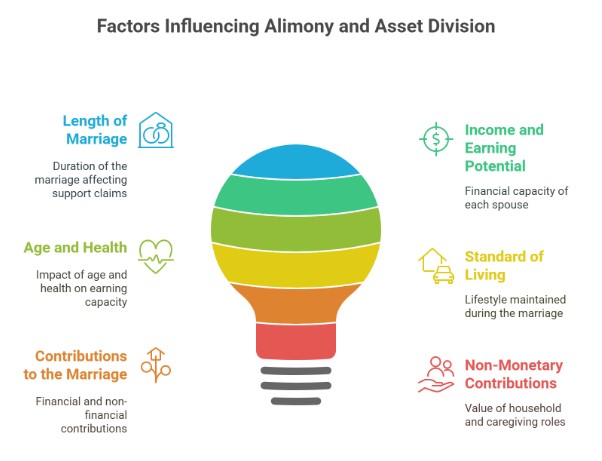
Maryland’s alimony statute requires courts to evaluate 12 factors before determining whether to award support, how much, and for how long. No single factor automatically controls the outcome — judges weigh each based on the specific circumstances of the marriage.
The 12 statutory factors include the recipient’s ability to become self-supporting, the time needed to gain sufficient education or training, the standard of living established during the marriage, the duration of the marriage, each spouse’s monetary and nonmonetary contributions, the circumstances that led to estrangement, the age of each party, each spouse’s physical and mental condition, the paying spouse’s ability to meet their own needs while supporting the other, any existing agreements between the parties, the financial resources of each spouse including retirement benefits, and whether the award would cause either spouse to become a resident of a related institution.
Divorce mediation allows both spouses to discuss these factors openly and negotiate alimony terms that reflect their actual financial circumstances — rather than leaving the decision to a judge who reviews the evidence in a single hearing.
How Asset Division Works in Maryland Divorce
Maryland follows a three-step process for dividing property in divorce: classify each asset as marital or nonmarital, determine the value of all marital property, and distribute it equitably based on 11 statutory factors under Family Law § 8-205.
Equitable distribution does not mean equal. A Maryland court can award one spouse a larger share of the marital estate if the statutory factors support that outcome. Courts cannot transfer most titled property directly between spouses — instead, they issue monetary awards to balance the distribution.
Marital Property vs. Separate Property
The distinction between marital and separate property determines what is subject to division.
Classification
Definition
Examples
Marital Property
Assets acquired by either spouse during the marriage, regardless of title
Family home, retirement accounts earned during marriage, joint bank accounts, vehicles purchased during marriage
Separate Property
Assets owned before marriage, gifts from third parties, inheritances
Premarital savings, inheritance received by one spouse, property excluded by prenuptial agreement
Mixed Property
Assets with both marital and nonmarital components
Home purchased before marriage with mortgage payments made during marriage
Maryland uses the “source-of-funds” tracing method established in Harper v. Harper (1982). Classification depends on where the money came from to acquire each asset — not whose name appears on the title.
When marital and nonmarital funds are commingled so that direct tracing becomes impossible, courts treat the entire asset as marital property.
Real property held as tenants by the entireties — the default title for married couples in Maryland — is automatically classified as marital property by statute, even if one spouse contributed premarital funds to the purchase.
Assets subject to division in mediation commonly include the family home, retirement accounts (401(k), 403(b), pensions, IRAs), investment portfolios, business interests, vehicles, bank accounts, and marital debt including mortgages, auto loans, and credit obligations incurred to acquire marital property.
Alimony and asset division decisions affect your financial future for years — Saunders Mediation helps Anne Arundel County couples negotiate fair terms in a private, structured setting.
Why Mediation Works for Alimony and Asset Division
Mediation offers a faster, less expensive alternative to litigating alimony and asset division in Maryland circuit court. Instead of presenting evidence before a judge who applies statutory factors and issues a ruling, both spouses work directly with a neutral mediator to negotiate terms that reflect their specific financial needs and priorities.
Mediation provides several advantages over litigation for financial disputes.
Control over outcomes. In court, a judge decides how to divide property and whether to award alimony. In mediation, both spouses retain decision-making authority and can craft creative arrangements — phased buyouts of the family home, structured alimony with built-in step-downs, or offset agreements that trade retirement account shares for other assets — that courts typically cannot order.
Confidentiality. Court proceedings create public records that expose financial details, income figures, and personal circumstances. Mediation sessions are private, and Maryland law protects mediation communications from disclosure in subsequent legal proceedings.
Speed. Contested divorce litigation in Anne Arundel County typically takes 12–24 months from filing to trial. Most mediated divorces resolve alimony and asset division within two to six sessions over a few weeks.
Lower cost. Litigation requires attorney fees for both sides, discovery costs, expert witness fees for property valuation, and court filing expenses. Mediation eliminates most of these costs while producing agreements that are equally enforceable.
If you’re ready to get
started, call us now!
How the Mediation Process Handles Financial Disputes
Saunders Mediation follows a structured process for alimony and asset division that ensures both spouses understand their financial positions before negotiating terms.
Financial disclosure. Both spouses compile complete financial inventories — income statements, tax returns, bank accounts, retirement account balances, real estate valuations, business interests, and debts. Full transparency is essential for fair negotiation and prevents disputes from resurfacing after the agreement is signed.
Issue identification. The mediator works with both spouses to identify every financial question that needs resolution: whether alimony is appropriate and in what form, how to classify and value each asset, how to handle the family home, how to divide retirement accounts, and how to allocate marital debt.
Guided negotiation. The mediator facilitates discussion on each issue, helping spouses move past entrenched positions toward terms that address both parties’ core financial needs. When spouses reach impasse on a specific issue, the mediator may use private caucuses — confidential one-on-one sessions with each spouse — to explore flexibility.
Settlement agreement. When both spouses reach agreement on all financial terms, the mediator helps draft a comprehensive settlement document that covers alimony type, amount, and duration; property distribution; debt allocation; retirement account division procedures (including QDRO requirements); and provisions for future modifications.
This signed agreement functions as a binding contract and can be incorporated into the final divorce decree.
How to Prepare for Alimony and Asset Division Mediation
Thorough financial preparation is the single most important factor in achieving a fair mediation outcome. Spouses who arrive with organized documentation and clear priorities resolve their disputes faster and with greater satisfaction.
Gather financial records. Collect at least two years of tax returns, current pay stubs, bank statements for all accounts, retirement account statements, mortgage documents, vehicle titles and loan balances, credit card statements, and any prenuptial or postnuptial agreements. Include documentation for business interests, stock options, and deferred compensation if applicable.
Understand the marital estate. Before the first session, develop a preliminary inventory of all assets and debts. Classify each item as marital, separate, or mixed property based on when and how it was acquired. The Maryland People’s Law Library provides a clear overview of classification rules.
Identify priorities. Rank your financial goals into three tiers: essential outcomes that are non-negotiable, preferred outcomes that are important but flexible, and ideal outcomes that could be traded in exchange for other priorities. This framework gives you clarity in negotiations and helps the mediator identify areas of potential agreement.
Consult an attorney if needed. Mediation does not require attorneys, but spouses with complex assets — business interests, multiple properties, pensions, or stock options — benefit from consulting a family law attorney before or between sessions to understand their legal rights and evaluate proposed terms.
How does Maryland determine whether alimony is appropriate?
Maryland courts must find that alimony is “necessary” before awarding it. Judges evaluate 12 statutory factors under Family Law § 11-106, including the duration of the marriage, each spouse’s earning capacity, the standard of living during the marriage, and both monetary and nonmonetary contributions.
What is equitable distribution in Maryland divorce?
Equitable distribution means Maryland courts divide marital property fairly based on 11 statutory factors — not automatically 50/50. The court evaluates each spouse’s contributions, financial circumstances, age, health, and the duration of the marriage to determine a fair allocation.
Can alimony be modified after the divorce is finalized?
Court-ordered rehabilitative and indefinite alimony can be modified if there is a material change in circumstances, such as job loss, disability, or significant income change. Spouses who include a non-modifiable clause in their mediated settlement agreement prevent future modification requests.
How long does alimony last in Maryland?
Duration depends on the type awarded. Rehabilitative alimony typically lasts two to five years. Indefinite alimony continues until a material change in circumstances, remarriage of the recipient, or death of either party. Mediation allows spouses to negotiate custom durations with built-in step-down provisions.
Is a mediation agreement for alimony and asset division legally binding?
A signed mediation settlement agreement is enforceable as a binding contract under Maryland law. When incorporated into the final divorce decree by the circuit court, it carries the full authority of a court order, and either party can seek enforcement for noncompliance.
What assets are subject to division in Maryland divorce?
Marital property subject to division includes all assets acquired during the marriage regardless of title — the family home, retirement accounts, bank accounts, vehicles, investments, and business interests. Separate property such as gifts, inheritances, and premarital assets remains with the original owner unless commingled.
How is the family home handled in mediation?
Spouses can negotiate several options: sell the home and divide the proceeds, have one spouse buy out the other’s equity share, or agree to deferred-sale arrangements that allow children to remain in the home. Mediation provides more flexibility than court-imposed solutions.
What happens to retirement accounts in a Maryland divorce?
Retirement benefits earned during the marriage are marital property. A division typically requires a Qualified Domestic Relations Order (QDRO) to transfer a portion of the account without triggering early withdrawal penalties or tax consequences. Mediation allows spouses to negotiate offset arrangements if preferred.
How much does divorce mediation cost compared to litigation in Maryland?
Mediation for alimony and asset division typically costs a fraction of contested litigation, which can run $50,000 to $200,000 or more per side in attorney fees, discovery, and expert witness costs over 12–24 months. Most mediated divorces resolve in a few sessions over several weeks.
Can mediation handle high-asset divorces with complex financial situations?
Mediation is effective for complex financial disputes including business valuations, multiple real estate properties, stock options, and deferred compensation. Spouses can bring financial advisors, forensic accountants, or appraisers into the process while maintaining the confidentiality and efficiency that litigation cannot provide.
Your financial future after divorce deserves careful, informed negotiation — Saunders Mediation helps Anne Arundel County couples protect their interests and reach agreements that work for both sides.