Small Claims Mediation in the Maryland District Court: Day-of-Trial vs. Pre-Trial ADR
Originally published: October 2025 | Updated: July 2026 | Reviewed by Don Saunders
The District Court of Maryland offers free mediation and settlement conferences in small claims disputes at two points: before your trial date, and on your trial date. Pre-trial ADR gives you scheduling flexibility and preparation time.
Day-of-trial ADR gives you one final chance to settle in a private courthouse room minutes before the judge calls your case.
Both processes are court-designated ADR under Maryland Rule Title 17, and both are free — unlike private civil mediation, which parties arrange and fund themselves. Which one fits depends on your preparation time and your pressure tolerance.
Key Takeaways
A small claim in Maryland is a civil action for money of $5,000 or less, filed in the District Court under Md. Code, Cts. & Jud. Proc. § 4-405.
The District Court ADR Office offers two distinct processes — mediation and settlement conferences — and neither carries a fee under Maryland Rule 17-305, while a small claims judge can award money and nothing else.
Pre-trial ADR in Anne Arundel County is available three weeks or more before the trial date and may be held remotely; day-of-trial ADR is in-person only.
Day-of-trial referrals happen inside the courtroom, and every party in the case must appear before a judge can send the matter to ADR.
Court dates arrive faster than most people expect. Saunders Mediation prepares Annapolis parties for District Court ADR long before the pressure builds — start the conversation.
What Is Small Claims Mediation in the Maryland District Court?
Small claims mediation is a free, court-referred process in which a neutral practitioner helps two parties in a District Court money case negotiate their own written settlement. The mediator resolves nothing; the parties do.
Maryland defines a small claim narrowly. Under Md. Code, Cts. & Jud. Proc. § 4-405, the District Court holds exclusive jurisdiction over any civil action for money in which the amount claimed does not exceed $5,000, excluding interest, costs, and recoverable attorney’s fees.
The same $5,000 ceiling applies to landlord-tenant rent claims brought under Real Property Article §§ 8-401 and 8-402. Small claims also run under simplified procedure: Maryland Rule 3-701(e) bars discovery entirely, and Rule 3-701(f) suspends the formal rules of evidence.
In mediation, an impartial mediator supports a conversation between participants and helps them build a resolution of their own creation. The mediator does not evaluate the case or propose solutions.
In a settlement conference, an experienced attorney serves as the neutral. That attorney may assess the strengths and weaknesses of each side’s position and may suggest terms to help the parties settle.
A party who wants an outside read on case value should request a settlement conference. A party who wants to control the terms without an evaluation should request mediation.
Who Serves as the Neutral
Court-designated practitioners meet the qualifications in Maryland Rule 17-304, which requires at least 40 hours of basic mediation training, completion of the District Court’s apprentice process, and adherence to the Maryland Standards of Conduct for Court-Designated Mediators adopted by the Supreme Court of Maryland.
Selection is not open to the parties in the court program: the ADR Office draws from an approved roster.
Confidentiality follows Maryland Rule 17-105, and its scope is narrower than most parties assume. The rule binds the mediator and anyone attending at the mediator’s request.
Parties themselves are bound when they sign a written confidentiality agreement, and the rule carves out exceptions for threats of serious harm, mandated abuse reporting, and claims of fraud or duress. Understanding mediation confidentiality before the session prevents an expensive surprise later.
If you’re ready to get
started, call us now!
Why Does the District Court Offer ADR at No Cost?
Maryland Rule 17-305 prohibits the District Court from charging litigants or their attorneys any fee or additional court cost for participating in a court-designated mediation or settlement conference. The policy is deliberate, and it rests on four practical grounds.
Access. Small claims parties usually represent themselves. A process that charged for the neutral would price out the people the $5,000 docket exists to serve.
Docket capacity. Every case that settles in a courthouse conference room frees trial time for a case that genuinely needs a judge.
Durability. Parties who write their own terms comply with them more consistently than parties who receive an order they opposed.
Scope. A judge in a small claim can award money and nothing else. A mediated agreement can include payment schedules, apologies, repairs, return of property, or future conduct.
That last point is the one most litigants underestimate. Maryland Rule 3-701 limits small claims relief to a money judgment, so a plaintiff who actually wants a fence moved or a job finished cannot get that from the bench. The mediation table is the only place in the process where those terms are available.
Cost is the other honest advantage. Court ADR carries no charge at all, which is a meaningful gap from private mediation rates in the Annapolis market.
The tradeoff is control: you do not select the court’s neutral, and you accept the court’s scheduling. Parties weighing court ADR against a private engagement should price both the free and the private route before deciding.
How Does Pre-Trial ADR Work in a Maryland Small Claims Case?
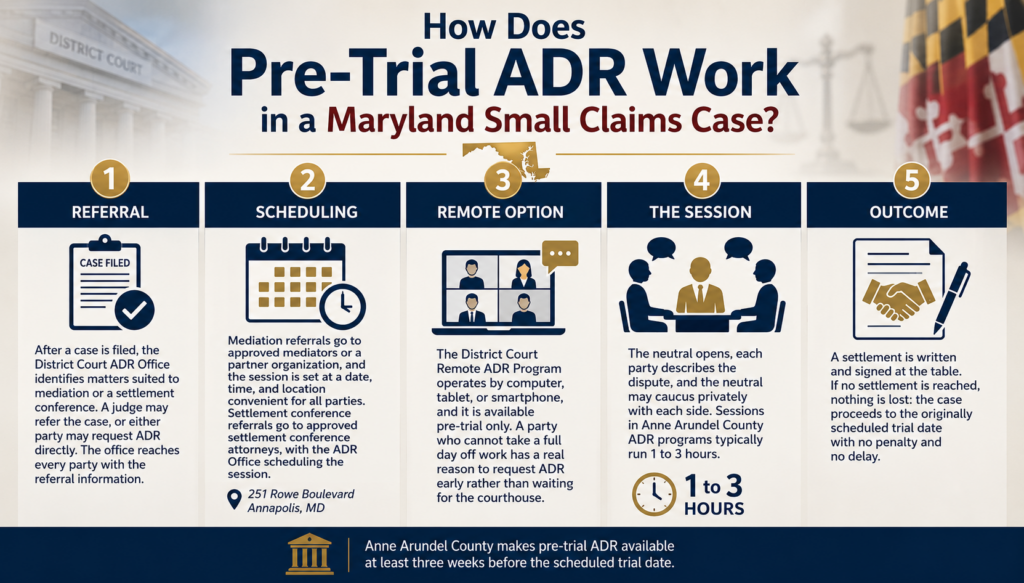
Pre-trial ADR happens on a date the parties help choose, weeks before trial, and may be conducted remotely. Anne Arundel County makes it available at least three weeks before the scheduled trial date.
Step 1 — Referral
After a case is filed, the District Court ADR Office identifies matters suited to mediation or a settlement conference. A judge may refer the case, or either party may request ADR directly. The office reaches every party with the referral information.
Step 2 — Scheduling
Mediation referrals go to approved mediators or a partner organization, and the session is set at a date, time, and location convenient for all parties. Settlement conference referrals go to approved settlement conference attorneys, with the ADR Office scheduling the session. Anne Arundel mediators serve the District Court location at 251 Rowe Boulevard in Annapolis, the same building that houses the statewide District Court ADR Office in Suite 307.
Step 3 — Remote Option
The District Court Remote ADR Program operates by computer, tablet, or smartphone, and it is available pre-trial only. A party who cannot take a full day off work has a real reason to request ADR early rather than waiting for the courthouse.
Step 4 — The Session
The neutral opens, each party describes the dispute, and the neutral may caucus privately with each side. Sessions in Anne Arundel County ADR programs typically run 1 to 3 hours.
Step 5 — Outcome
A settlement is written and signed at the table. If no settlement is reached, nothing is lost: the case proceeds to the originally scheduled trial date with no penalty and no delay.
If you’re ready to get
started, call us now!
What Happens During Day-of-Trial ADR at the Courthouse?
Day-of-trial ADR is offered in person on the trial date and begins inside the courtroom rather than at the clerk’s counter. Referral comes from the judge, or from a party who asks for it.
Referral Requires Full Attendance
Every party in the case must appear for the judge to refer the matter to ADR. One absent defendant ends the option immediately, which is why day-of-trial ADR fails as a strategy in cases where the other side has been unresponsive. This is the same structure Maryland uses in rent court disputes on high-volume docket days.
The Session Moves to a Private Room
Once referred, the parties leave the courtroom for a private room inside the courthouse. The neutral runs the same process used pre-trial — opening statements, questions, private caucuses — compressed into the window before the judge reaches the rest of the docket.
Two Possible Endings
Parties who agree sign a written settlement, and the terms are reported to the court. A signed settlement is a contract, and its enforceability is fixed the moment both signatures land on the page. Read the payment dates, the total, and the release language before signing, because a courthouse corridor is a poor place to discover an ambiguity.
Parties who do not agree return to the courtroom for the scheduled court process. The trial proceeds that day, before the same judge, with no adverse inference drawn from the failed session.
Walking into a courthouse unprepared costs more than time. Don Saunders helps Anne Arundel parties frame realistic terms before the mediator arrives — get ready now.
How Do Pre-Trial and Day-of-Trial Mediation Compare?
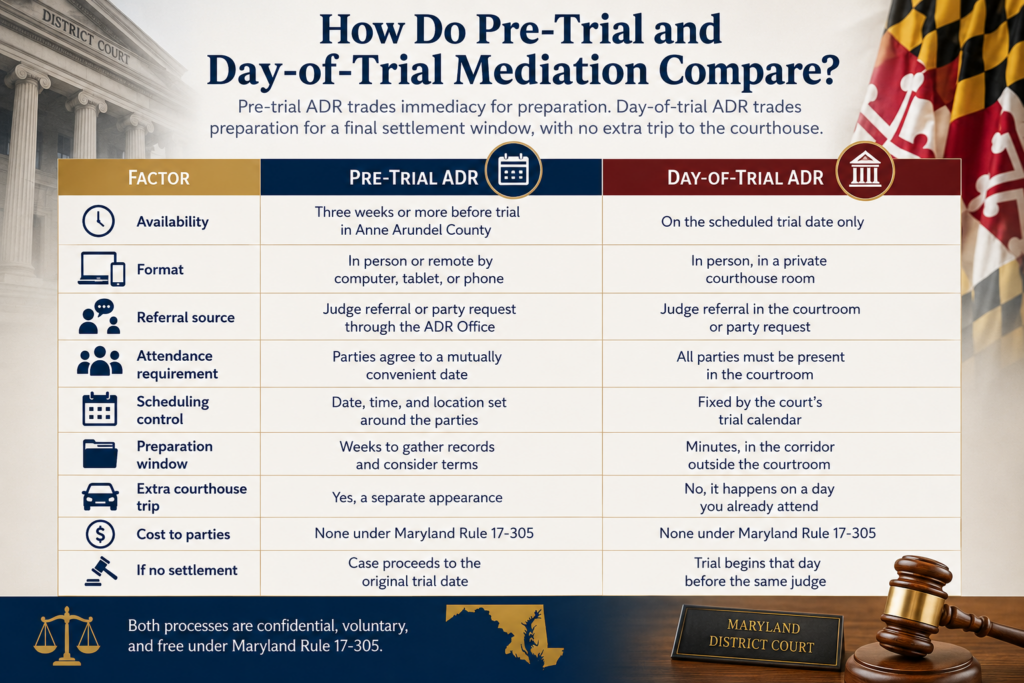
Pre-trial ADR trades immediacy for preparation. Day-of-trial ADR trades preparation for a final settlement window, with no extra trip to the courthouse.
Factor
Pre-Trial ADR
Day-of-Trial ADR
Availability
Three weeks or more before trial in Anne Arundel County
On the scheduled trial date only
Format
In person or remote by computer, tablet, or phone
In person, in a private courthouse room
Referral source
Judge referral or party request through the ADR Office
Judge referral in the courtroom or party request
Attendance requirement
Parties agree to a mutually convenient date
All parties must be present in the courtroom
Scheduling control
Date, time, and location set around the parties
Fixed by the court’s trial calendar
Preparation window
Weeks to gather records and consider terms
Minutes, in the corridor outside the courtroom
Extra courthouse trip
Yes, a separate appearance
No, it happens on a day you already attend
Cost to parties
None under Maryland Rule 17-305
None under Maryland Rule 17-305
If no settlement
Case proceeds to the original trial date
Trial begins that day before the same judge
The choice usually resolves along one line: how much of your case still needs to be assembled. A dispute over a returned deposit with a signed lease and a bank record is ready for a corridor conversation.
A dispute over workmanship, partial performance, or a running account requires documents first, which is the pattern in most contract disputes.
Availability is the second filter. Day-of-trial services are not offered at every District Court location, and a party who assumes otherwise can arrive with no ADR option at all. Confirming availability with the ADR Office beforehand takes one phone call.
Parties already ordered into mediation in a related matter should flag that history, because it shapes how the neutral opens the session.
How Should You Prepare for a Small Claims Mediation Session?
Preparation determines outcomes more reliably than argument does. Because Rule 3-701(e) bars discovery in small claims, whatever you bring to the table is the entire evidentiary universe of the case.
What to Bring
Why It Matters
Applies To
Signed contract, lease, or written agreement
Fixes the terms both sides actually accepted
Both parties
Invoices, receipts, and payment records
Establishes the running balance without argument
Both parties
Texts, emails, and written notices
Shows what was promised and when
Both parties
Dated photographs of damage or work performed
Replaces competing descriptions with evidence
Claimant, usually
Repair estimates from a third party
Anchors the number to an outside source
Claimant
A written bottom line and a walk-away number
Prevents an emotional decision under time pressure
Both parties
A payment schedule you can actually meet
Converts a disputed lump sum into a workable plan
Defendant
Two habits separate parties who settle from parties who do not. The first is arriving with a number and a range rather than a position.
The second is preparing a settlement you can live with even if the other side never concedes fault, because a small claims mediation resolves money and terms, not blame.
Neither habit requires legal training, and neither is something the neutral will do for you — court-designated certified mediators are barred from advising either side.
A third habit is quieter and matters just as much: decide in advance what you will accept in place of money. Small claims disputes are frequently about a repair that was never finished, a deposit that was never itemized, or an invoice nobody explained. Judges cannot order any of those remedies.
A mediator can write them into an agreement the same afternoon, provided one party thought to ask. Parties who arrive with only a dollar figure in mind often leave with less than the process could have given them, because the non-monetary terms were never raised.
Rehearsing the opening also pays off. Two or three sentences that state what happened, what you want, and what you are prepared to accept will do more work than a folder of documents nobody reads aloud.
Anne Arundel parties seeking a fuller picture of what the county offers can review local ADR resources before their session. The District Court ADR Office is reachable at 410-260-1676, and the Remote ADR Program at 410-260-1971.
What Happens If Small Claims Mediation Does Not Settle Your Case?
A failed session costs you nothing procedurally. The case returns to the docket on its original schedule, and the judge hears it under the same simplified small claims rules.
Outcome
What Happens Next
Full settlement
Written agreement signed; terms reported to the court and the claim resolved
Partial settlement
Agreed issues documented; the remaining issues go to the judge
No settlement, pre-trial ADR
Case proceeds to the originally scheduled trial date with no delay
No settlement, day-of-trial ADR
Parties return to the courtroom and trial begins that day
A party fails to appear
No referral is made; the case proceeds on the docket
Trial in a small claim is informal by design. The formal rules of evidence do not apply under Rule 3-701(f), so a party may hand the judge a text message or a photograph without laying a foundation.
The Maryland People’s Law Library maintains a plain-language walkthrough of the filing and trial steps for self-represented parties.
Knowing what happens when mediation fails removes most of the risk from trying it in the first place.
Confidentiality also survives the impasse. Communications protected under Rule 17-105 do not become admissible simply because the session ended without agreement, which is one reason parties can negotiate candidly without weakening their trial position.
The protection is not absolute, though. Rule 17-105 carves out threats of serious bodily harm, mandated child abuse reporting, allegations of mediator misconduct, and claims that an agreement was procured by fraud, duress, or misrepresentation. Treat those four categories as the outer limit of what stays in the room.
Partial agreements are also worth pursuing when a full settlement stays out of reach. Parties who resolve liability but not amount, or amount but not timing, can document what they settled and hand the judge a narrower question. A shorter trial is a cheaper trial, and a narrowed dispute is easier to resolve on the courthouse steps.
Settlement is also not a single event. Parties frequently reach terms in the days after a session, once the numbers have been sitting a while, and the mechanics of what happens after mediation accommodate a late agreement filed any time before trial begins.
One practical note for claimants: winning a small claims trial and collecting on the judgment are separate problems. A judgment is a piece of paper until the losing party pays it or you pursue enforcement.
A mediated payment schedule that the other side helped design is often collected faster than a judgment that the same person fought and lost, which is a reason to take the free session seriously, even when your evidence looks strong.
Contact Us Today For An Appointment
Frequently Asked Questions
What is small claims mediation in the Maryland District Court?
Small claims mediation is a free, court-referred process where a neutral mediator helps parties in a District Court money case under $5,000 negotiate their own written settlement. The mediator does not evaluate the case, decide the outcome, or suggest terms.
Is small claims mediation required in Maryland?
No. Participation is voluntary. A judge may direct a case into court-ordered mediation, and parties may request ADR themselves, but no one can be compelled to settle. If no agreement is reached, the case simply proceeds to trial on its original date.
How much does District Court small claims mediation cost?
Nothing. Maryland Rule 17-305 prohibits the District Court from requiring litigants or their attorneys to pay any fee or additional court cost for a mediation or settlement conference conducted by a court-designated practitioner. Private mediation arranged outside the court program is billed separately.
What is the difference between mediation and a settlement conference?
A mediator stays impartial, does not evaluate the case, and does not propose solutions. A settlement conference uses an experienced attorney who may assess each side’s strengths and weaknesses and may suggest terms. Request the settlement conference when you want an outside evaluation.
How far in advance can I request pre-trial ADR?
Anne Arundel County offers pre-trial ADR three weeks or more before the scheduled trial date. Requesting earlier gives the ADR Office room to find a date convenient for everyone and preserves the remote option, which is unavailable on the trial date.
Can small claims mediation be done remotely in Maryland?
Yes, but only before the trial date. The District Court Remote ADR Program runs on a computer, tablet, or smartphone and is available pre-trial only. Day-of-trial ADR services are offered in person at the courthouse, with no remote alternative. Plan the request accordingly.
Are small claims mediation agreements binding in Maryland?
Yes. A settlement signed by both parties is a binding, enforceable contract. If a party later breaches the terms, the other party can pursue enforcement through the court. Read every term carefully before signing, because the informality of a small claim does not reduce enforceability.
Do I need a lawyer for small claims mediation?
No. Most small claims parties appear without counsel, and the docket is built for self-representation. An attorney consultation before the session can still help you value the claim, organize records, and judge whether a proposed settlement is reasonable. Bring organized records either way.
Is free court ADR better than hiring a private mediator?
Neither is universally better. Court ADR costs nothing but assigns the neutral and the schedule. Weighing ADR and litigation against a private engagement usually turns on how much scheduling control, subject-matter experience, and session length your particular dispute actually requires.
What happens if the other party does not show up on the trial date?
Every party must appear for a judge to refer the case to day-of-trial ADR. If someone is absent, no referral is made and the case simply proceeds on the docket that morning. This is a strong argument for requesting pre-trial ADR instead.
What happens after a small claims mediation settles?
The signed agreement is reported to the court and the claim resolves without a trial. Next steps depend on the terms: some settlements are paid on the spot, and others run on a payment schedule the parties set themselves and monitor without further court involvement.
Does anything said in mediation come out at trial?
Maryland Rule 17-105 protects mediation communications in court-ordered and court-referred cases. The rule binds the mediator and those attending at the mediator’s request, binds parties who sign a written confidentiality agreement, and carves out exceptions including threats of serious harm and fraud claims.
A judge’s ruling ends the argument but rarely satisfies anyone. Saunders Mediation helps Annapolis parties reach terms they choose themselves — settle on your terms.